






























Data lineage tracks the complete journey of your data from source to destination, documenting every transformation, dependency, and policy along the way. For organizations in regulated industries, lineage is the foundation that makes compliance provable, change predictable, and data trustworthy.
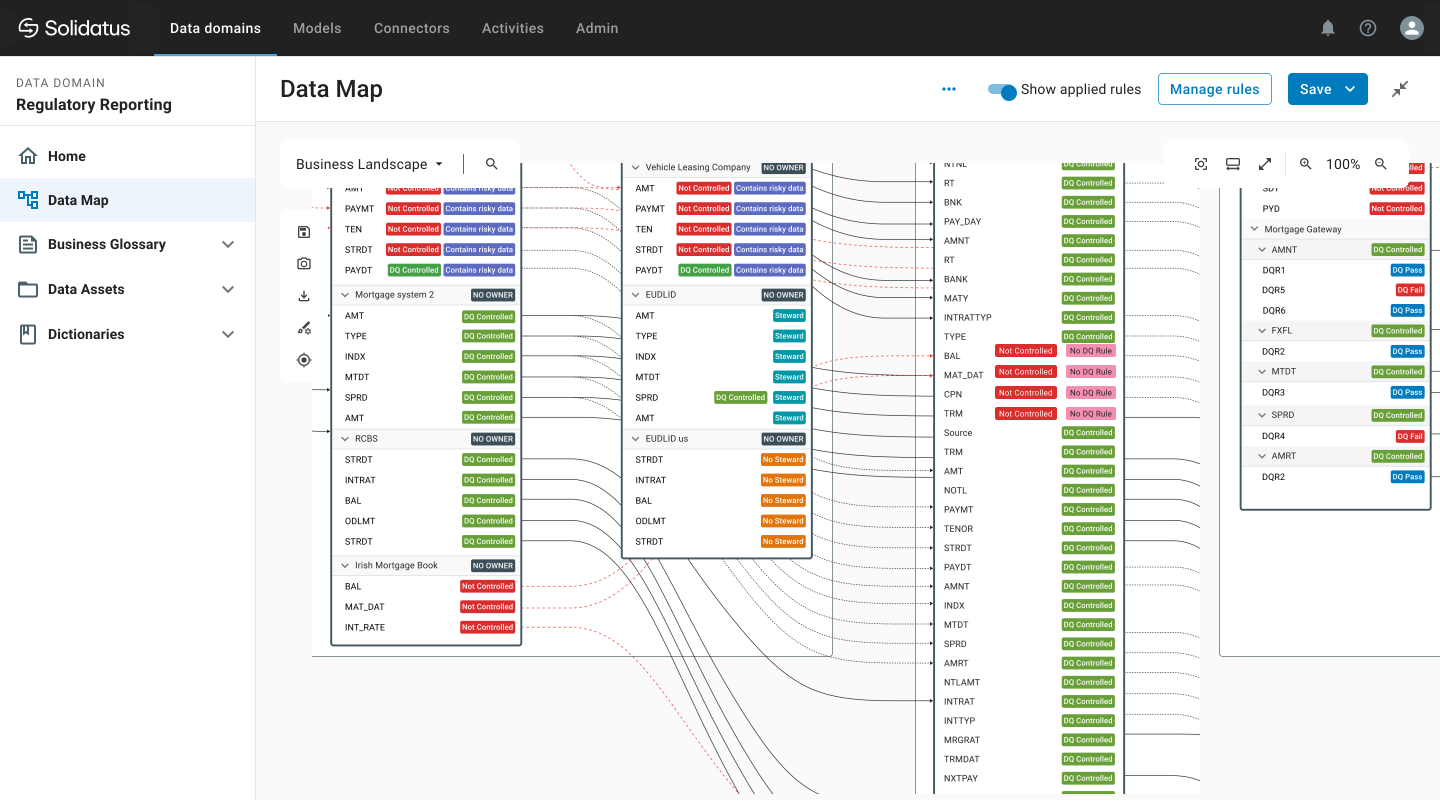
Solidatus is the business lineage platform for complex, regulated data estates. It maps the complete journey of data from source through every transformation to consumption, connecting technical flows to compliance rules, ownership, SLAs, and AI provenance at column-to-policy depth.
What is data lineage?
Data lineage is a record of where your data comes from, how it changes, and where it goes. It documents the full lifecycle of data as it moves through your organization, from the source system where it originates, through every transformation and enrichment step, to the dashboards, reports, and AI models that consume it.
A complete lineage record answers three questions that every data leader faces:
- Where did this data come from? Trace any data element back to its authoritative source, including intermediate systems and transformations.
- What happened to it along the way? See every ETL process, aggregation, filter, join, and business rule that shaped the data before it reached its current form.
- Who depends on it downstream? Identify every report, model, regulatory filing, and business process that would be affected if this data changed.
Lineage can be captured automatically through metadata extraction and visualized at different levels of detail. High-level views show data moving between systems. Granular views track column-level transformations and their usage in dashboards, compliance reports, and AI training pipelines. This flexibility makes lineage accessible to both technical teams and business stakeholders.
A data catalog indexes what data exists and where it lives. Data lineage goes further by mapping how data flows, transforms, and connects across your entire estate. The two are complementary, but lineage answers the harder questions, the ones that surface during audits, incident response, and AI model validation.
How data lineage works
Data lineage records each stage of the data lifecycle so you can trace any piece of information with confidence. A continuously updated lineage record captures:
Origin
The source system where data is created or ingested, whether a transactional database, third-party feed, IoT sensor, or manual entry.
Movement
The path data takes through your organization, including transfers between databases, data lakes, warehouses, and cloud storage.
Transformation
Every processing step that alters the data, including ETL (Extract, Transform, Load) jobs, aggregations, calculations, joins, filters, and business rules.
Policy and ownership
The governance rules, regulatory requirements, data classifications, and accountable owners attached to each data element.
Consumption
The downstream systems, reports, dashboards, analytics models, and AI applications that depend on this data.
Metadata
Supporting information such as data type, format, structure, quality scores, timestamps, SLAs, and risk ratings.
Advanced lineage platforms map both direct and indirect relationships between data entities, connect technical flows to business processes and compliance controls, and provide impact analysis that shows what breaks when something changes upstream.
Example: A financial transaction in a retail bank
A customer makes a payment with their debit card. The transaction data (origin) is routed through a fraud detection engine and enriched with geolocation data (transformation). It is then stored in the bank’s core accounting system (storage) and later consumed by monthly compliance reports, customer account dashboards, and credit risk models (consumption).
At each step, metadata documents the source of the transaction, every transformation applied, and when the data was accessed. This transparency allows the bank to detect errors quickly, demonstrate regulatory compliance during audits, and assess the downstream impact if the fraud detection rules change.
Why data lineage matters now
Three forces are converging to make data lineage a strategic priority for regulated enterprises.
Regulatory pressure is intensifying
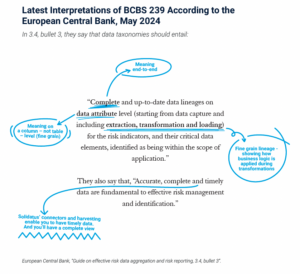
BCBS 239 requires banks to demonstrate accurate, complete, and timely risk data aggregation. DORA mandates operational resilience testing across digital systems. The EU AI Act requires organizations to document the provenance and quality of data used in AI systems. Without automated lineage, responding to these requirements means weeks of manual tracing and the risk that your answers are incomplete.
AI adoption demands data provenance
Every AI model is only as trustworthy as the data that feeds it. Organizations deploying machine learning and generative AI need to trace where training data came from, whether it is legally permissible to use, and what happens to model accuracy when upstream sources change. Data lineage provides that provenance chain.
Hybrid estates are growing more complex
Most enterprises now operate across on-premises systems, multiple cloud providers, SaaS applications, and legacy mainframes. Data flows through dozens of systems before reaching a decision-maker. Without lineage that spans the full estate, you have visibility into fragments but not the complete picture.
Types of data lineage
Data lineage operates at different levels of detail depending on who needs the information and what questions they need to answer.
Business lineage
“Can I trust this number?”
A high-level view of how data flows from source systems to business outcomes. Shows which reports depend on which sources, which compliance filings are connected to which data feeds, and who is accountable at each stage.
Connects data flows to ownership, SLAs, risk ratings, and regulatory tags.
For: CDOs, governance leaders, compliance officers, business analysts
Technical lineage
“What exactly happened to this data?”
Granular, column-level detail about transformations. Shows how data is extracted, joined, filtered, and aggregated across pipelines. Enables diagnosis of quality issues, pipeline change planning, and downstream dependency assessment.
For: Data engineers, data architects, IT operations
End-to-end lineage
The complete picture
Combines business and technical views in a single, navigable environment. A compliance officer traces a filing back to source columns. A data engineer sees which business reports depend on their pipeline.
This integrated view is what separates advanced lineage platforms from basic metadata trackers.
Data lineage for AI governance
As organizations deploy AI at scale, they face a new category of governance questions that traditional data management tools were not designed to answer. Data lineage fills that role by connecting AI outputs back to their data inputs with full traceability.
Data provenance for AI models
Every AI model depends on training data, and that data has a history. Data lineage traces the full provenance chain from raw source data through every cleaning, enrichment, and feature engineering step to the final training dataset. This provenance record answers the questions regulators and risk committees are asking:
- Where did the training data originate, and is it legally permissible to use?
- Has the training data been filtered for bias, PII, or quality issues?
- Which upstream changes could degrade model accuracy?
Change impact on AI models
When an upstream data source changes format, frequency, or quality, downstream AI models can degrade silently. Data lineage enables proactive impact analysis. Before deploying an upstream change, you can identify every AI model, dashboard, and report that depends on the affected data and assess the risk before anything breaks.
Meeting emerging AI regulations
The EU AI Act requires organizations deploying high-risk AI systems to document the data used in training and validation, including its provenance, quality characteristics, and any known limitations. NIST’s AI Risk Management Framework recommends similar transparency practices. Data lineage provides the audit-ready documentation these frameworks require.
Benefits of data lineage

Prove
Show exactly where data comes from and how it changes
Regulatory compliance
Generate audit-ready documentation for BCBS 239, DORA, GDPR, CCPA, and the EU AI Act. Replace weeks of manual tracing with automated lineage extraction.
Data trust
Give business users confidence that numbers in reports and dashboards are accurate, complete, and sourced from authoritative systems.
AI provenance
Demonstrate that AI training data is legally permissible, properly governed, and traceable to its source.

Predict
See the downstream impact of changes before they happen
Impact analysis
Before modifying a data source, pipeline, or business rule, identify every downstream report, model, and process that depends on it.
Cloud migration planning
Map data dependencies across hybrid and multi-cloud environments with full visibility into what will be affected.
Change management
Provide stakeholders with clear evidence of change impact to secure executive support and align cross-functional teams.

Protect
Reduce the risk of compliance breaches and operational disruption
Incident prevention
Identify data quality issues, broken pipelines, and compliance risks before they reach production systems or regulatory filings.
Operational resilience
Maintain clear visibility into data dependencies so you can recover quickly from infrastructure failures, cyber incidents, or vendor disruptions.
Data security
Track the flow of sensitive and regulated data across your estate, ensuring alignment with classification policies and access controls.
Use cases and examples
Regulatory compliance and audit readiness
Financial institutions use data lineage to demonstrate BCBS 239 compliance by tracing risk data aggregation from source systems through to regulatory reports. A global investment bank used Solidatus to automate this process, reducing change impact assessment time from months to minutes.
Read the HSBC case studyAI model validation and governance
Data science teams use lineage to validate the provenance of AI training data, assess the impact of upstream data changes on model accuracy, and generate the documentation required by the EU AI Act and internal model risk management frameworks.
Watch the BNY webinarCloud migration and modernization
Royal London Asset Management used Solidatus to map 175,000+ fields across 41 source systems as part of a migration from thinkFolio and Murex to BlackRock Aladdin, combined with a cloud transformation.
Read the RLAM case studySelf-service analytics and data trust
Business analysts use lineage to verify the source and quality of data in their dashboards and reports. When a number looks wrong, lineage provides the trail to diagnose the issue without filing a ticket with IT.
Watch the LSEG webinarOperational resilience and incident response
When a data pipeline fails or a source system goes down, lineage shows which downstream processes are affected, enabling faster triage and targeted remediation.
See all Solidatus case studiesBest practices
Best practices
Do not try to map your entire data estate at once. Begin with the data flows that carry the most regulatory, financial, or operational risk. Build outward from there.
Automate lineage extraction
Manual lineage documentation (spreadsheets, Visio diagrams) goes stale the moment someone changes a pipeline. Use automated metadata extraction to keep lineage current and accurate across ETL tools, BI platforms, databases, cloud services, and custom applications.
Connect technical lineage to business context
Technical lineage tells you what happens to data. Business lineage tells you why it matters. The most effective implementations link column-level transformations to the business processes, compliance rules, ownership, and SLAs that give them meaning.
Frequently asked questions
01.
What is the difference between data lineage and a data catalog?
A data catalog indexes what data exists and where it lives. Data lineage maps how data flows, transforms, and connects across systems. A catalog tells you “this table exists in Snowflake.” Lineage tells you “this table is fed by three ETL jobs, enriched with reference data from two sources, and consumed by four regulatory reports and an AI model.” The two are complementary, but lineage answers the harder operational and compliance questions.
02.
What is business lineage vs. technical lineage?
Technical lineage shows granular, column-level detail about data transformations. Business lineage shows how data flows connect to business outcomes, compliance filings, ownership, and accountability. The most effective data lineage platforms combine both views so that a compliance officer can trace a regulatory report back to its source columns, and a data engineer can see which business processes depend on a pipeline they need to change.
03.
Why is data lineage important for AI?
AI models depend on training data, and that data has a history of transformations, filters, and enrichment steps. Data lineage provides the provenance chain that connects AI outputs back to their original data sources. This provenance is essential for validating that training data is legally permissible, free from quality issues, and properly governed. It also enables impact analysis, identifying which AI models would be affected by upstream data changes before those changes are deployed.
04.
What regulations require data lineage?
Several regulatory frameworks either require or strongly imply the need for data lineage. BCBS 239 requires banks to demonstrate accurate and timely risk data aggregation, which depends on traceable data flows. DORA mandates operational resilience testing for digital systems in financial services. The EU AI Act requires documentation of data provenance for high-risk AI systems. GDPR and CCPA require organizations to trace how personal data is collected, processed, and shared.
05.
How does data lineage support cloud migration?
Cloud migration projects fail when organizations lack visibility into data dependencies. Data lineage maps which downstream reports, models, and processes depend on the systems being migrated. This visibility lets you plan the migration sequence, identify risks before cutover, and validate that data flows are intact after the transition.
06.
What is bi-temporal data lineage?
Bi-temporal lineage records both the business time (when a data event occurred in the real world) and the system time (when it was recorded or modified in your systems). This capability lets you view your data estate as it existed at any point in the past, understand how it has evolved, and plan future-state transformations. Bi-temporal lineage is particularly valuable for regulatory audits, where you may need to reconstruct the state of your data as of a specific reporting date.
07.
How does data lineage differ from data mapping?
Data mapping links specific data fields from one system to corresponding fields in another. Data lineage is broader. It captures the full journey of data across all systems, including every transformation, enrichment, and consumption point. Data mapping answers “which field maps to which.” Data lineage answers “how does data flow through the entire organization, and what depends on it.”
08.
Can data lineage be automated?
Yes, and automation is essential for keeping lineage accurate at enterprise scale. Modern lineage platforms extract metadata automatically from ETL tools, BI platforms, databases, cloud services, and custom applications. They detect changes in data flows and update the lineage record without manual intervention. The most advanced platforms also support manual curation for business context, including ownership, SLAs, risk ratings, and policy mappings, that cannot be inferred from metadata alone.
What to look for in a data lineage platform
When evaluating data lineage solutions, these capabilities separate platforms built for regulated enterprises from basic metadata trackers:
End-to-end coverage
Can the platform map data flows across hybrid, multi-cloud, and legacy systems in a single view?
Column-to-policy depth
Does lineage connect granular technical transformations to business policies, compliance rules, and regulatory requirements?
Business context
Can you attach ownership, SLAs, risk ratings, and accountability to data flows, or is the lineage purely technical?
Bi-temporal capability
Can you view your data estate as it existed at any past point and model planned future states for audits and transformation planning?
AI provenance
Does the platform trace the data feeding AI models, including training data origins, quality characteristics, and upstream change impact?
Automated extraction with manual curation
Does it support both automated metadata ingestion and manual enrichment for business context that cannot be inferred from metadata alone?
Impact analysis
Before a change is deployed, can you see every downstream report, model, and process that depends on the affected data?
Why Solidatus
We are the data lineage company. We built Solidatus for the organizations where lineage matters most: complex, regulated enterprises with hybrid data estates spanning cloud, on-premises, and legacy systems.
Complete lineage
Map the full data journey across every system in your estate, from mainframes to cloud-native platforms. Track lineage at column-to-policy depth with bi-temporal capability that lets you view past, current, and planned future states.
Business context built in
Connect technical data flows to the business processes, compliance rules, ownership, SLAs, and risk ratings that give them meaning.
AI-ready from day one
Trace the provenance of AI training data, assess the impact of upstream changes on model accuracy, and generate the audit documentation required by the EU AI Act and NIST AI RMF. The AI Lineage Assistant lets you ask questions in natural language and get lineage answers instantly.
Proven at enterprise scale
HSBC
Modelled 2,000 source tables with 80,000+ fields and 20,000+ data linkages across 45 source systems, reducing credit decisions from months to minutes. Winner of the 2023 Banking Tech Award for “Best Use of Tech in Business Lending.”
Royal London Asset Management
Mapped 175,000+ fields across 41 global systems to support a data migration to BlackRock Aladdin and a cloud transformation.
Global investment bank
Automated BCBS 239 compliance and reduced change impact assessment time from months to minutes.

Written by: Philip Dutton
Co-Founder & CEO at Solidatus Philip is a Senior System Architect and Project Manager with over 20 years’ experience within Financial Services.