














































Data Distress: Data Leaders on Brink of Quitting Jobs

27 July 2023, London and Houston: An alarming 71%[1] of senior global data leaders within financial services firms surveyed who experience stress in the workplace are ready to quit their job due to high levels of work-related stress with 87%[2] saying it affects their mental health and well-being, according to new research by data management firm Solidatus.
With 64%[3] experiencing high levels of stress in the workplace, which causes more than two-thirds (61%) to suffer from between two and six nights of disrupted sleep per week, it appears that senior data leaders are in an intense state of anxiety and potentially heading for burnout.
Solidatus’ research, conducted in collaboration with market-research firm Censuswide, surveyed 300 senior data leaders across the UK and the US in the financial services sector.
Respondents cite the top three causes of data distress as:
Philip Dutton, CEO and Founder of Solidatus, warned that each of these factors compound the others and result in a fundamental breakdown in trust, which drives even higher levels of stress.
He said: “Data has become the lifeblood of organizations, driving innovation and decision-making. However, the exponential growth of data, the atomization of data supply chains, the tsunami of regulation and the ever-increasing rate of change of business processes and systems has created almost unmanageable complexity. The resultant demands and pressures faced by data leaders have given rise to a mounting crisis: data distress. This is particularly acute in financial services, where our research found elevated levels of workplace data stress, which is having a significant impact on mental health. Left unchecked, this could have serious consequences across the organizations that rely on the expertise and leadership of these individuals.”
He said: “Data has become the lifeblood of organizations, driving innovation and decision-making. However, the exponential growth of data, the atomization of data supply chains, the tsunami of regulation and the ever-increasing rate of change of business processes and systems has created almost unmanageable complexity. The resultant demands and pressures faced by data leaders have given rise to a mounting crisis: data distress. This is particularly acute in financial services, where our research found elevated levels of workplace data stress, which is having a significant impact on mental health. Left unchecked, this could have serious consequences across the organizations that rely on the expertise and leadership of these individuals.”
Data distress is taking its toll on the job satisfaction and performance of today’s financial services data leaders – 80%[4] said the high level of stress at work impacts their ability to do their job properly, rising to 86%[5] among 25- to 34-year-olds.
79% of respondents who have been at their company for 1-4 years agree[6] that this level of stress makes them want to leave their job, compared to 62% of those who have been in their job for 5+ years. This indicates that the less time you are in a job, the more stress you experience and the greater the urge you have to quit your job
Tough regulatory requirements contributing to data distress
But despite 83%[7] feeling confident about their company’s ability to collate and report the right data for regulatory requirements, it still takes too much time. Almost a third (32%) of respondents say their team spends four to five hours per week managing data for financial regulations. Nearly three-quarters (73%) believe that up to half their time in this pursuit is wasted through inefficiencies, such as poor systems and data.
As a result, just under half (47%) say ‘lack of data management tools’ is one reason why managing data for financial regulation takes as long as it does and is so stressful. Over a third (34%) state that it’s because ‘our data sets are all in siloed systems’ and 32% believe ‘we don’t have a good view of our full data estate’.
Dutton added: “Lack of data trust, decreasing efficiencies, increases risk and ultimately creates data distress. With such a seismic shift in organizations’ data, and regulatory and change environments, a totally new operating model needs to be deployed, supported by modern data management tools designed to cope with infinitely connected and complex environments within financial organizations. Urgent action is needed to deal with data distress and protect the mental health of the custodians of organizations’ most valuable asset – their data.
“Organizations’ data management foundations and supporting structures need to be replaced to enable simplicity, transparency, and understanding to promote implicit data trust. Only then will data leaders operate in a sustainable environment free from data distress.
“What’s more, if the pressure to go faster continues to induce data distress, with tactical firefighting and fine avoidance being the default, productivity and opportunity discovery will be stifled. With global banking estimated to be worth around $20 trillion per year[8], even as little as a 5% drop in strategic activity due to data distress represents a $1 trillion reduction in value.”
Dannielle Haig is an independent Business Psychologist who coaches senior business leaders.
She said: “In today’s data-driven world, the abundance and chaos of information are having a severe impact on data leaders. The sheer volume, velocity, and variety of datasets available are overwhelming and taking a toll on their mental health and well-being.
“To navigate this data deluge, it is crucial for data leaders to prioritize self-care. By fostering a healthy work-life balance and seeking support with the right tools and techniques – which can increase their capacity to make better decisions that they’re more confident in and to de-risk – they can maintain their mental stability, manage their spiralling datasets and lead with optimism, clarity and resilience.”
-ENDS-
To find out more about the Solidatus ‘Data Distress’ report, please download it here:https://www.solidatus.com/resource/data-distress-is-the-data-office-on-the-brink-of-breakdown/
The research was conducted by Censuswide from 19.05.2023 – 26.05.2023. An online survey reached 308 Senior Data Leaders (CDOs etc.) in the financial services sector, aged 18+, across the UK and USA. Censuswide abides by and employs members of the Market Research Society which is based on the ESOMAR principles.
Solidatus is an innovative data management solution that empowers organizations to connect and visualize their data relationships, simplifying how they identify, access, and understand them. With a sustainable data foundation in place, data-rich enterprises can meet regulatory requirements, drive digital transformation, capture business insights, and make better, less risky and more informed data-driven decisions. We provide solutions to several key areas of endeavor, including governance and regulatory compliance; data risk and controls; business integration; environment, social, governance (ESG); and data sharing. Our clients and investors include top-tier global financial services brands such as Citi and HSBC, healthcare, and retail organizations as well as government institutions.
[1] 71% combines “Strongly agree” and “Somewhat agree”
[2] 87% combines “Significantly impacts” and “Somewhat impacts”
[3] 64% combines “Always high” and “Sometimes high”
[4] 80% combines “Significantly impacts” and “Somewhat impacts”
[5] 86% combines “Significantly impacts” and “Somewhat impacts”
[6] Agree combines “Strongly agree” and “Somewhat agree”
[7] 83% combines “Very confident” and “Somewhat confident”
[8] In September 2021, Investopedia said that “Market estimates project that by the end of 2021, the financial services market is likely to reach $22.5 trillion,” in an article entitled Financial Services: Sizing the Sector in the Global Economy. See also McKinsey’s Global Banking Annual Review, published December 2022.
Published on: July 27, 2023

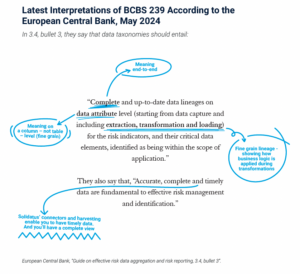
In May 2024, the ECB released its ‘Guide on effective risk data aggregation and risk reporting (RDARR)’...
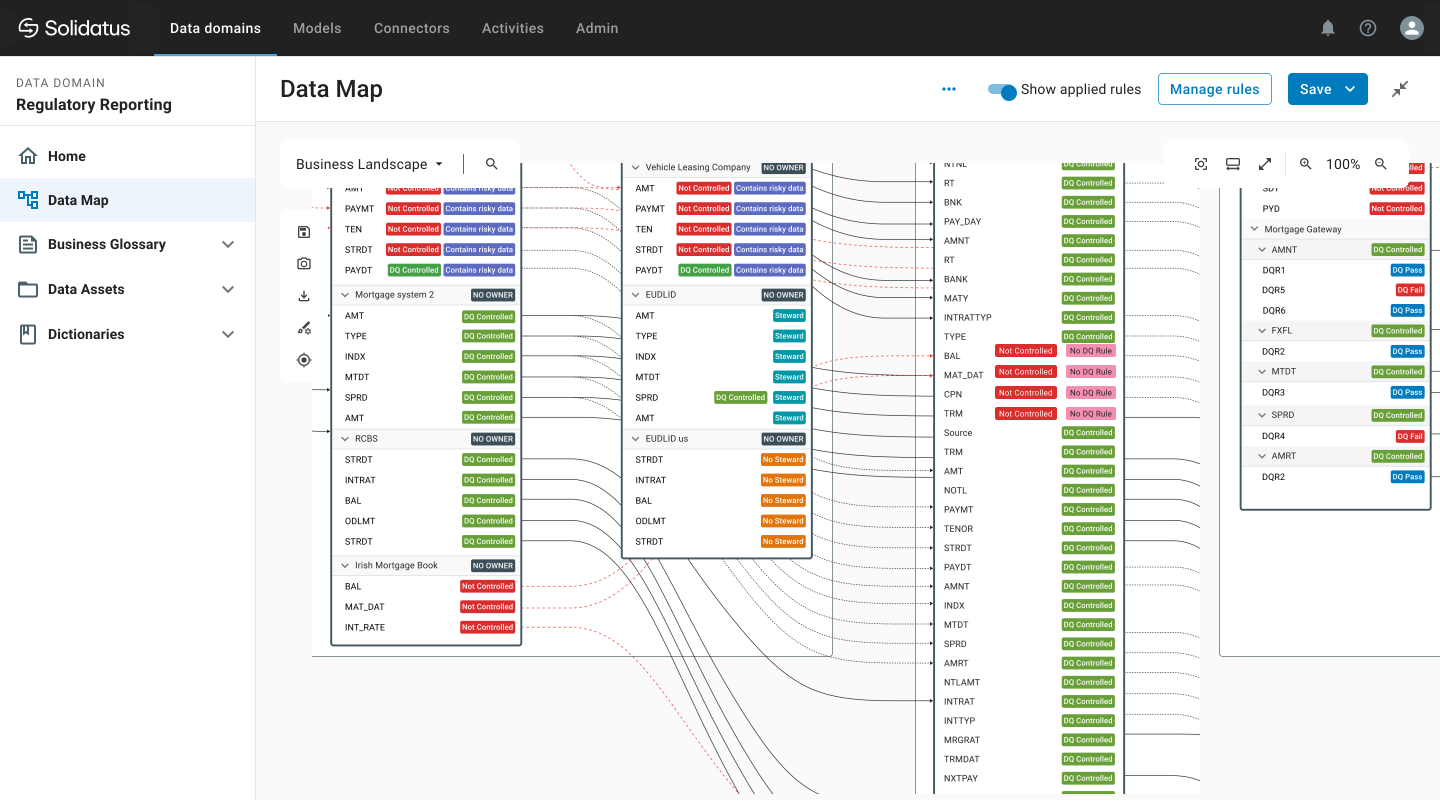
Read why advanced data lineage is crucial for business success
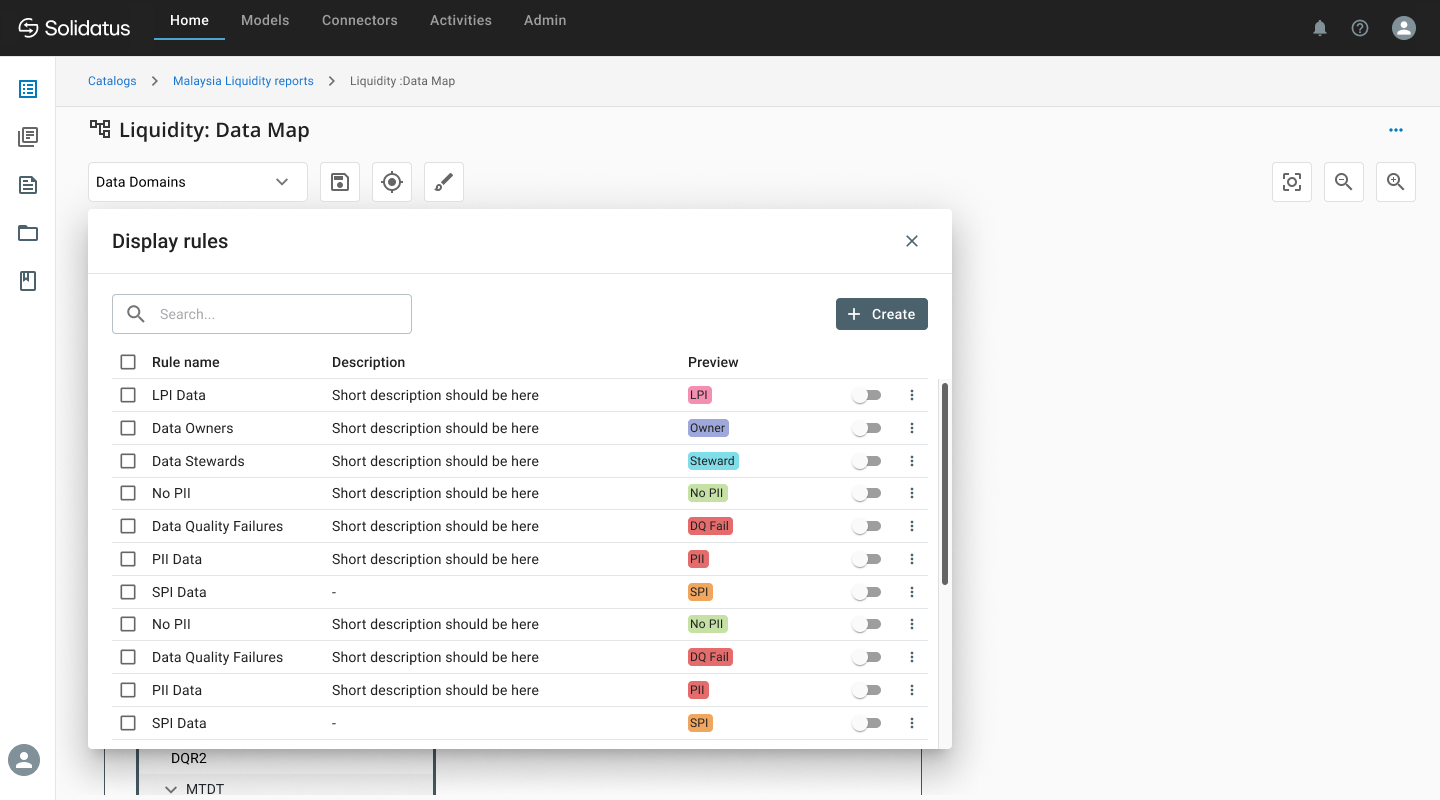
An update on some recent developments in our latest product releases
Read more about data lineage and its business impact, including on AI, BCBS 239 and more
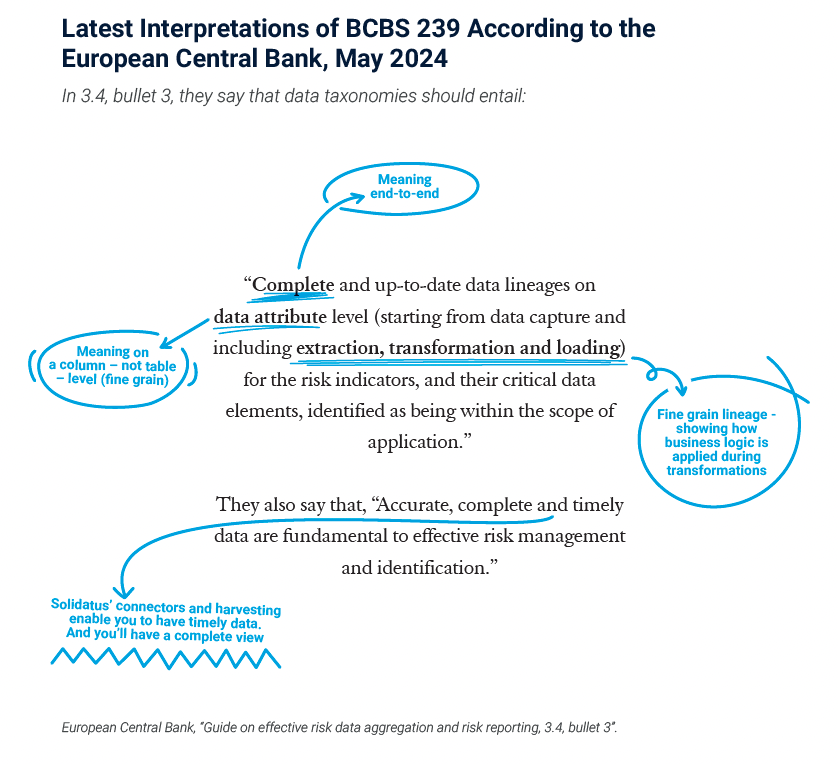
Navigate BCBS 239’s rigorous standards with advanced data lineage
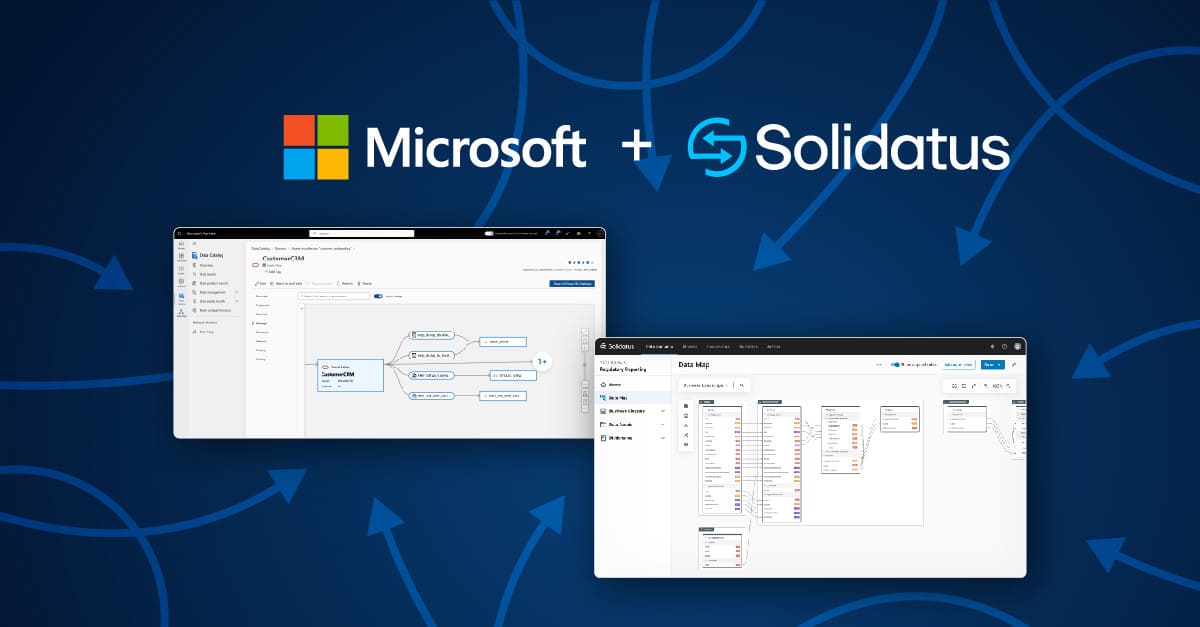
Solidatus data lineage partners with Microsoft Purview to help enterprises trust their data

Read about the new Solidatus interface
Read our key takeaways from Gartner D&A Summit 2024

Video introducing our new interface and core features like Connected Catalog and Data Map
Read about Solidatus and Snowflake Horizon's governance solution

Explore the various aspects of data lineage and its crucial role in your organization.

Basel III is changing – are you prepared? Read 3 easy steps with Solidatus
Read how we helped successfully launched the Houston Women in Data Chapter

Exploring the parallels between urban planning and data planning projects

Take a look at what's new in our partnership with Snowflake

VP Product, Tina Chace, reflects on the Gartner conference, covering data governance and AI

We’ve linked the Eurovision Song Contest to the realm of data governance and data lineage

In the latest Gartner® research note, find out what active metadata is

The role of metadata, dynamic visualization and inference across metadata

Automatic connectors are essential for efficiently mapping metadata but not all are created equal. We look at the most important...

We discuss injecting active metadata into your governance and 4 other things we’re looking forward to at the Gartner® Data...

Subscribe for the latest news, blogs, and resources.