








































Data lineage vs metadata management: The architecture behind AI governance

A data catalog and a data lineage platform are often compared on features but this falls short; the sharper comparison is architectural. Metadata management was built to index what data exists and help people find it. Data lineage was built to model how data moves, transforms, and connects across systems. Catalogs answer “what do we have?” Lineage platforms answer “where did it come from, what changed it, and what depends on it?” AI governance depends heavily on the second set of questions, and enterprises that treat the two categories as interchangeable end up with architectures that fail their first real AI audit.
That distinction has moved out of the specialist debate and into the boardroom. Gartner now publishes three distinct research streams covering these capabilities in 2025 and 2026, each treating data lineage as a mandatory feature but with different architectural assumptions about where it lives and what it does. The categories are specializing rather than merging, and lineage has become the layer that runs through all three. We promised in “The engineering of trust” that we would come back and map these differences in full. This is that piece.
The easiest way to see the difference is to compare what each category treats as its primary object.
| Metadata management | Data lineage | |
|---|---|---|
| Primary object | Dataset records, labels, classifications | Relationships between data elements |
| Primary job | Discovery, labeling, self-service | Audit, impact analysis, provenance |
| Primary output | A searchable inventory of assets | A navigable dependency model |
That difference in primary object produces two genuinely different architectures, and the choice of architecture constrains what the tool can do later. In a catalog-first platform, the index is the foundation. Relationships between data elements are derived from connector-captured metadata and expressed as a lineage view on top of the catalog. When automation stops, the model stops, because there is no modeling surface to continue the map by hand. The map was never the primary object.
A lineage-first platform flips that structure. The relationship model is the foundation, and catalog metadata such as ownership, labels, classifications, and policies attach to the map as context. When automation stops, a modeler picks up the pen, because the map remains the primary object. This is why lineage-first platforms can represent manual, legacy, and undocumented flows that catalog-first tools cannot see.
The architectural difference becomes apparent the moment a lineage encounters a missing node. A catalog-first tool ends the map there. A lineage-first tool treats that node as a placeholder waiting to be filled. For an auditor, the practical stakes are obvious. A modeled node labeled “pending validation” fits a governance framework.
A dead-end with “we cannot describe what depends on this data element” does not meet the expectations of BCBS 239 or the EU AI Act.
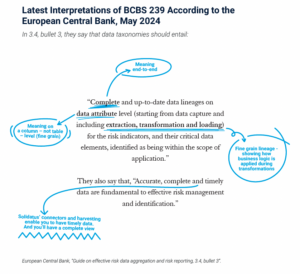
“Data lineage at the data attribute level is a minimum requirement of an effective data governance framework.”
— European Central Bank, Guide on Effective Risk Data Aggregation and Risk Reporting, May 2024
Microsoft, which has its own native lineage capability within Purview, chose to partner with a lineage specialist vendor as its Data Lineage Integration Partner. When the largest catalog-integrated platform recognizes that its lineage layer needs an engineering-grade companion, the category argument has moved past theory into procurement.
Most lineage vendors duck this point, so let’s make it plain. Data catalogs are not bad tools. They are very good at what they were designed for: discovery, self-service search, glossary management, and stewardship workflows. An analyst looking for a table and its owner has a catalog as the right tool. The error is expecting a catalog to do the work of a lineage platform, even as the governance question shifts to provenance, impact, and auditability.
Catalogs serve discovery, labeling, and classification for analysts and data consumers. Lineage platforms serve audit, impact, and provenance for risk, compliance, and AI governance teams. These workflows run on different cadences, serve different audiences, and rely on different data models underneath. An enterprise that runs both jobs through a single catalog is asking an indexing engine to do engineering work.
The same limitation applies in reverse to pure-play lineage tools. Technical-only lineage platforms solve the automated-mapping half of the problem and stop there. They produce accurate schema-level flow maps, but those maps cannot answer governance questions about the flows themselves.
Consider a concrete failure mode. A technical lineage map shows that Column X feeds Column Y. Nothing in the map tells you that Column X carries GDPR special-category data, that Column Y is an input to a credit-decisioning model now in production, or that the source system’s service-level agreement changed last quarter. That context sits in a business context layer, which is absent from a technical-only platform by design.
The complete picture of regulated AI comprises three layers: the complete technical lineage, business context, and AI readiness. Catalogs cover some of the business context layer. Pure-play lineage covers some of the technical flow layer. No single category covers all three in one model, which is why AI governance so often ends up requiring three vendors stitched together at integration time.
The architecture that worked for periodic audits does not survive contact with AI. Three forces changed what governance has to deliver.
Regulators now specify lineage granularity. The European Central Bank’s May 2024 guidance states that data lineage at the data attribute level is a minimum requirement for effective risk data aggregation. The EU AI Act imposes transparency obligations on the provenance of training data for high-risk systems. Regulators no longer ask whether a dataset exists in your catalog. They ask how it was transformed before it reached a production model, and they expect the answer at the attribute level.
The question has shifted from a technical to a meaningful one. A regulator investigating an adverse AI decision asks which policy governed this data, who owned it, what risk classification applied, and whether the transformation between source and model preserved those attributes. That answer requires a business-context-aware flow diagram that ties ownership, policy, and risk to every node in the chain. Technical-only lineage shows the plumbing without explaining the meaning.
Model failures trace through the data supply chain. When a production model starts returning biased or inaccurate outputs, someone has to trace the dependency back to the original source. A catalog cannot surface that dependency because it indexes what exists rather than what depends on what. A schema-only lineage tool can show the dependency, but cannot link it to the business process or policy that broke. The teams that can trace a model failure end-to-end are the ones whose architecture connects both layers.
The scale of this work is becoming visible at real institutions. One UK-based asset manager preparing a platform migration had to map more than 2,000 source tables, 175,000 fields, and 99,000 data attribute flows across 41 systems before it could greenlight the program, with ownership, policy, and downstream dependency attached to each node. A catalog search could not have answered that question, and neither could a schema-only lineage map.
The clearest evidence that the category lines are moving comes from the research community. Gartner now maintains three distinct research streams covering these capabilities, each published within a year of the others.
The Magic Quadrant for Metadata Management Solutions (November 2025) describes a market “undergoing a significant evolution, shifting from augmented data catalogs to metadata ‘anywhere’ orchestration platforms.”1 The Magic Quadrant for Data and Analytics Governance Platforms (January 2026) defines a separate category focused on policy setting and enforcement, with data lineage as a mandatory capability.2 The Market Guide for AI Governance Platforms (November 2025) describes an emerging market adjacent to both, one that depends on data governance and data lineage capabilities to function.3
The D&A Governance Platforms Magic Quadrant is explicit about what lineage has to do.
“Data lineage must be broad because it must audit and, wherever needed, infer all the steps, applications and transformations that any data element has gone through from its original source to all the possible endpoints, including AI models. It must be deep to allow for drilling down or analyzing to the finest level of detail, such as column-level or transformation logic.”
— Gartner, Magic Quadrant for Data and Analytics Governance Platforms, January 2026
That is the analyst community describing, in its own words, why lineage depth matters and what end-to-end means. The definition rules out two familiar shortcuts. A catalog’s lineage tab cannot meet the breadth requirement across hybrid estates. Schema-level technical mapping cannot meet the depth requirement at the column level or in the transformation logic.
For CDOs running an evaluation today, three dimensions deserve weight on the RFP scoring matrix. Lineage depth at the data attribute level, end-to-end across hybrid and legacy sources. Governance integration, with technical flow, policy, ownership, and risk classification in the same model rather than stitched across products. AI readiness, meaning training-data provenance, model-change impact analysis, and audit-ready evidence for regulators. A vendor can usually demonstrate one of the three. Some can demonstrate two. Very few demonstrate all three in one architecture.
The difference between an indexing architecture and an engineering architecture is easiest to surface with specific demo requests. Three probes will tell you more than a feature matrix.
Probe 1. The manual bridge. Walk me through a lineage map where automation did not reach. Show me how your modeler bridges that section by hand, how the bridged segment persists across re-scans, and how the manual entries carry forward when the underlying system changes. If the demo cannot show this, the architecture has answered for itself.
Probe 2. The single model. Show me the same data element in three views: technical flow, policy and ownership, and AI training provenance. Is that one model with three lenses, or three models stitched together through integration? The answer reveals whether business context lives inside the lineage model or has been bolted on after the fact.
Probe 3. The historical state. Re-run a lineage query against the state of the estate six months ago. What does your platform show, and at what granularity? This probes bi-temporal capability, which is the minimum architectural requirement for AI forensics and audit reconstruction. A platform that only shows the current state cannot help you answer “what did the model see when it made the decision?”
These three probes will identify which vendors were built for indexing and which were built for engineering. That distinction, rather than the feature count on the demo scorecard, determines whether your governance architecture can survive contact with AI.
The question is not data lineage versus metadata management. It is whether your governance architecture was built for indexing or built for engineering. Indexing answers the question “what data do we have?” Engineering answers the questions “where did it come from, what depends on it, and can we prove it?” AI governance is an engineering problem, and regulators are writing engineering requirements into law.
The institutions moving furthest on AI governance stopped asking which category wins and started asking which architecture can carry lineage, governance, and AI readiness in one connected model. That is the architectural shift the analyst community is describing, and it is the shift regulators are now auditing against.
In the next piece in this series, we will look at what regulators specifically expect to see when they ask about your lineage, and how the demands of BCBS 239, DORA, and the EU AI Act converge on the same architectural requirements.
Ready to see what engineering-grade lineage looks like for AI governance?
Request a demo of the Solidatus AI Lineage Assistant →
1Chien, Melody, Thornton Craig, Guido De Simoni, and Roxane Edjlali. “Magic Quadrant for Metadata Management Solutions.” Gartner, November 19, 2025. Report ID G00808349.
2Raj, Anurag, Guido De Simoni, and Sarah Turkaly. “Magic Quadrant for Data and Analytics Governance Platforms.” Gartner, January 6, 2026. Report ID G00828171.
3Kornutick, Lauren, Sumit Agarwal, Avivah Litan, Svetlana Sicular, Priya Sundararaman, and Souparna Palit. “Market Guide for AI Governance Platforms.” Gartner, November 4, 2025. Report ID G00837249.
01.
Metadata management indexes what data exists, who owns it, and how it should be used, producing a searchable inventory for analysts and data consumers. Data lineage maps how data moves, transforms, and connects across systems, producing a navigable dependency model for audit, impact analysis, and provenance work. Both categories are useful in a regulated enterprise, but they solve different problems. AI governance depends heavily on lineage, because proving how training data was transformed requires a relationship model, not a list of assets.
02.
A data catalog cannot replace a data lineage platform for AI governance work. Catalogs are built on an indexing architecture, which treats dataset records as the primary object and derives lineage as a view on top. When automation fails to resolve a flow, a catalog-first tool has no modeling surface to continue the map by hand. Lineage-first platforms treat the relationship model as the foundation, allowing modelers to represent manual, legacy, and undocumented flows that catalogs cannot see. For BCBS 239 and EU AI Act compliance, that difference is not optional.
03.
AI governance requires data lineage because regulators now demand attribute-level traceability of training data. The European Central Bank’s May 2024 guidance names data lineage at the data attribute level as a minimum requirement for effective risk data aggregation. The EU AI Act attaches transparency obligations to training-data provenance for high-risk systems. A data catalog can tell an auditor that a dataset exists. Only a lineage platform can show how it was transformed before it reached a production model, which is the evidence regulators and risk officers now expect.
04.
Complete AI governance requires three layers in one connected model: complete technical lineage across hybrid and legacy systems; business context that ties ownership, policy, risk classification, and process to every node; and AI readiness covering training-data provenance, model-change impact analysis, and audit-ready evidence for regulators. Data catalogs cover part of the business context layer. Technical-only lineage tools cover part of the technical flow layer. No single category covers all three, which is why AI governance architectures often require multiple vendors stitched together at integration time.
05.
Three probes surface more than a feature matrix. First, ask the vendor to walk through a lineage map where automation did not reach and show how the modeler bridges that section manually. Second, ask to see the same data element in three views (technical flow, policy and ownership, and AI training provenance) and confirm whether it is one model or three stitched together. Third, ask the platform to re-run a lineage query against a historical state of the estate. These probes distinguish architectures built for indexing from architectures built for engineering.
06.
The EU AI Act requires organizations deploying high-risk AI systems (such as those used in credit scoring, hiring, insurance underwriting, or law enforcement) to provide transparency about training-data provenance and the logic behind decisions. Meeting this requirement calls for end-to-end traceability at the data attribute level, tying each data element back to its origin, transformation history, and governing policies. A data catalog that only indexes what exists cannot produce that evidence. Lineage at the attribute level, connected to business context, is the architectural minimum.
Published on: June 4, 2026

What your data lineage has to prove before an examiner asks about a past decision

What runtime capture reaches, and what you have to model yourself.

Why a residency commitment is not evidence of custody.

Why data governance programs fail

Three criteria that make regulatory data lineage reusable

How data lineage brings assessment discipline to financial services data flows

A buyer's guide to choosing the foundation of your AI stack.

Pre-change impact analysis for data estates that feed AI

MCP support, Bring Your Own LLM, and an assistant that keeps its context

Bi-temporal data lineage is the foundation of forensic AI investigation

Why an AI use policy cannot enforce itself.

When an AI model starts producing unexplainable results, the first instinct is to blame the model. Teams often rush to...

What regulators are already asking about your AI, and what it takes to respond

Three questions your AI governance approach must answer

Three institutions receive the same question during Model Risk Management reviews: “Walk us through the complete data lineage for your...

Solidatus’ Tina Chace and fellow experts reveal why 90% of AI model failures trace back to upstream data changes

AI-ready data lineage is a comprehensive, auditable record of how data flows through your organization, designed to support AI governance...
An update on some recent developments in our latest product releases
Read more about data lineage and its business impact, including on AI, BCBS 239 and more
Solidatus data lineage partners with Microsoft Purview to help enterprises trust their data

VP Product, Tina Chace, reflects on the Gartner conference, covering data governance and AI