






































Your riskiest change ticket says low risk

Pre-change impact analysis for data estates that feed AI
The scenario is illustrative but familiar to anyone who runs a large data estate. A data engineering team consolidates two reference-data feeds into one. The change ticket says low risk. The cutover runs clean and nothing pages. Three weeks later, a pricing model that learned its behavior from the deprecated feed is scoring customers on outdated assumptions, and the first person to notice works in a business unit the ticket never mentioned.
Every enterprise measures impact. Most measure it in the postmortem, where the only available question is what the change broke. The valuable question comes earlier, while the change is still a ticket. For data ecosystems that feed AI systems, impact analysis has to move from a forensic exercise after the incident to a pre-change computation, run on the data lineage graph before anything ships. Teams that make that move stop discovering their dependencies from incident reports.
Application monitoring is built for problems that announce themselves. A failed job retries, an error rate crosses a threshold, and someone gets notified via Slack. When a machine learning (ML) model loses an upstream assumption, nothing triggers a notification. The model was trained on data as it looked at a point in time, and it carries that snapshot in its weights. When a data feed consolidation changes an encoding or a default value, the model continues to produce confident predictions based on dated assumptions that are no longer valid. Every upstream system reports healthy, because nothing in the software failed. What changed is the meaning of the data, the underlying assumptions, and nothing in the typical monitoring stack watches for meaning.
Data science teams that have deployed ML inside regulated banks learn to draw an operational line through model drift. Data drift that follows an upstream change is structural and can be detected and flagged to downstream owners as part of the change process itself. Concept drift, where the world moves away from the training data, resists prediction. Drift caused by your own change ticket is knowable in advance, which makes it the portion of model risk that an architecture prevents. Machine learning systems are brittle in this specific way, and data environments that respect the brittleness treat an upstream change to a model’s inputs as a model risk event until the lineage shows otherwise.We have written before about how a two-line change to an address field can significantly impact a model’s accuracy, and that story starts in the data supply chain, and so does the fix.
The depth problem compounds as consumers multiply. A traditional report reads from a handful of curated tables. An AI agent assembling a decision pulls from whatever sources its task requires, at whatever moment it runs. Hence, a single reference column now sits inside the dependency set of consumers its owner has never met.
US supervisors have started to write this arithmetic into guidance. SR 26-2, the model risk guidance that replaced SR 11-7 this April, directs banks to manage aggregate risk, the exposure that builds when many models lean on the same data, assumptions, or methods, as noted in our piece on forensic lineage. The key signal for architects sits in the guidance’s third footnote, where the agencies placed generative and agentic AI outside its scope and told banks to extend the principles to those systems through their own governance programs, with a request for information signaled to follow.1 The set of consumers a change can reach is widening faster than the rulebook that governs it.
When an examiner asks what else moves when this input moves, the answer has to exist before the change does.
Computationally, data lineage impact analysis is a graph traversal. It starts at the element a change ticket proposes to affect and follows every downstream edge, collecting the consumers, owners, and obligations it passes through. Two properties of the underlying lineage graph decide whether that result can be trusted.
Both properties decay unless capture runs continuously. A graph that was accurate at last quarter’s audit computes last quarter’s impact, and systems change every week. Gartner’s research on agentic AI risk points in the same direction, recommending lineage tracked at the column or attribute level so teams can pinpoint which data modification produced which inaccuracy, and warning that manual tracking cannot be sustained across modern cloud and hybrid architectures.2
Traversing the current data estate answers what a change will touch. The stronger discipline models the change itself before it exists. Software engineering solved this years ago with staging environments, where a change runs against a faithful copy of production before anyone trusts it. A version-controlled lineage graph gives the data estate the same machinery. Branch the model, apply the proposed change, and diff the branch against production to see what moves.
Royal London Asset Management (RLAM) plans change this way at scale. The firm, which manages £162.3 billion in assets, modeled its migration from thinkFolio and Murex to BlackRock Aladdin, alongside a cloud replatforming, as future states in Solidatus. The underlying graph spans 2,000 source tables and more than 175,000 fields, with 126 reports and 99,000 data attribute flows across 41 source systems.3 Version history and branching let the team assess candidate scenarios before committing, with downstream dependencies and the transformation path visible for each option.
Run the opening scenario through the same discipline, and the outcome changes. The feed consolidation exists as a branch before becoming a cutover. The diff lists the pricing model among the affected consumers with its owner attached, and the conversation about retraining happens before the change ships instead of three weeks after.
A traversal that returns 40 downstream nodes has not yet answered anything a change board can use. Physical-only lineage tools stop there. The node list says which columns, jobs, and reports sit downstream. It does not say which of those reports carries a regulatory obligation, who owns the consuming application, or whose quarter is about to be ruined. Someone still has to do that archaeology by hand, and the ticket usually ships while they do it.
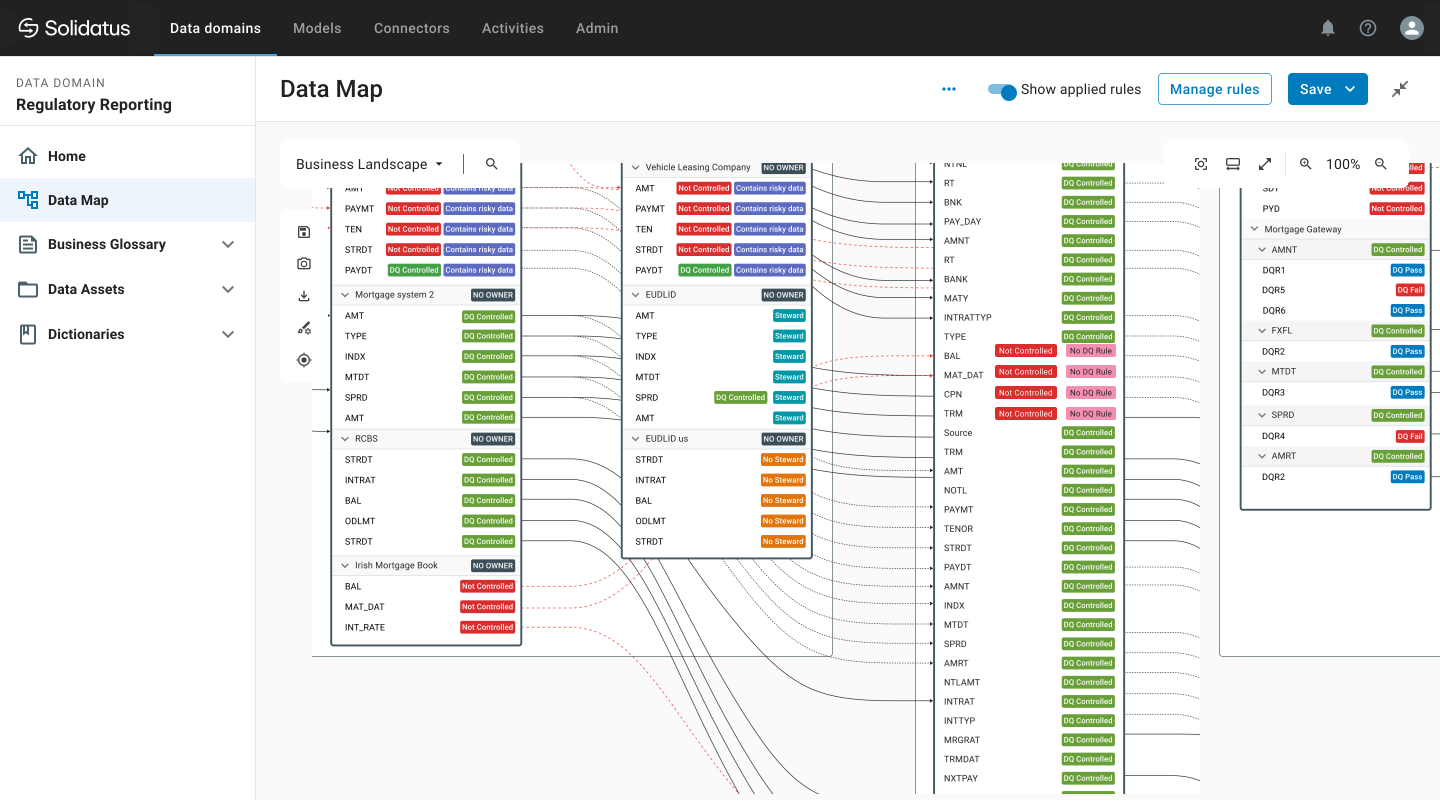
Business context converts the node list into a decision. When owners, policies, and regulatory obligations are shown on the same graph as the physical flows, the traversal returns the people to notify and the obligations at stake, rather than a set of node IDs. Large banks now run data governance as federated teams embedded in business units, and a shared impact analysis workflow lets a change proposed in one unit reach the right owner in another before it lands.
“The true brilliance of Solidatus lies in its capability to capture the physical aspects of data and seamlessly link them back to your catalogs and critical business information.”
— Lynn Watts, Head of Data Management and Governance, RLAM
AI systems now author changes as well as consume them. The Solidatus AI Lineage Assistant drafts mappings and proposes connections across the lineage model, enriching technical and business metadata as it works. Every proposal it makes is staged for validation, shown as a visual diff, and held for human approval before anything reaches production. An agent’s proposed change and an architect’s proposed change flow through the same gate, and the same pre-change impact computation evaluates both. As agentic tooling authors a growing share of the data estate’s changes, that single gate is how change review keeps pace with the volume of change.
Three moves turn impact analysis from an aspiration into an operating practice.
If you would rather see the computation run against your own estate than read about it, ask for a technical demo or an architecture workshop, and bring the change ticket you are least sure about.
[1]Board of Governors of the Federal Reserve System, FDIC, and OCC. “Supervisory Guidance on Model Risk Management.” SR Letter 26-2, April 17, 2026.
https://www.federalreserve.gov/supervisionreg/srletters/SR2602.htm.
[2]De Simoni, Guido. “Data Lineage Is Essential to Manage the Risks of Agentic AI.” Gartner, March 24, 2026. G00847339 (subscription required).
[3]Solidatus. “Royal London Asset Management Builds Operational Data Blueprint with Solidatus Data Lineage.” 2024.
https://www.solidatus.com/wp-content/uploads/2024/06/RLAM-Case-study.pdf.
01.
Impact analysis is the computation that determines, before a change ships, which downstream reports, models, and applications a data change will affect. It works by traversing the data lineage graph, starting at the element a change ticket touches and following every downstream edge to collect the consumers, owners, and regulatory obligations it passes through. Run before cutover, it turns dependency discovery from a post-incident exercise into a standard part of the change process.
02.
Data observability detects problems after deployment by watching pipelines and outputs for anomalies. Impact analysis computes the set of affected consumers before a change ships. The two are complementary, but machine learning weakens an observability-only approach because a model that loses an upstream assumption keeps producing confident scores without raising an error. For data estates that feed AI systems, a pre-change computation on the lineage graph catches what post-deployment monitoring cannot see.
03.
A change usually touches a field, not a whole table. Lineage that resolves at the table or system level, which is where most data catalogs stop, returns every consumer of the table and produces oversized impact sets that teams learn to ignore. Column-level data lineage separates the consumers of the changed field from the neighbors that share its table, which keeps the computed impact set small enough to act on.
04.
A future-state model is a branch of a version-controlled lineage graph that represents a proposed change before it is implemented. Teams apply the change to the branch and diff it against production to see every affected consumer in advance, mirroring the same pattern staging environments provide for software engineering. Royal London Asset Management used future-state modeling in Solidatus to plan its migration to BlackRock Aladdin across a graph of 2,000 source tables and more than 175,000 fields.
05.
SR 26-2, the US model risk guidance that replaced SR 11-7 in April 2026, directs banks to manage aggregate risk, the exposure created when many models rely on the same data or assumptions. It also excludes generative and agentic AI from its scope and asks banks to extend the principles through their own governance programs. Computed impact analysis on changes to shared data feeds addresses both by making the concentration visible and the review repeatable.
06.
Start by enumerating one production model’s upstream dependencies at the column level; where the enumeration stops marks your coverage shortfall, not the limit of your exposure. Then require a computed impact analysis on any change ticket that touches a shared data feed, with owners and obligations attached to the result. Solidatus, a business data lineage platform, supports this with column-level traversal, modeled coverage of systems scanners cannot reach, and version-controlled branching for future-state modeling.
Published on: July 21, 2026

What your data lineage has to prove before an examiner asks about a past decision
What runtime capture reaches, and what you have to model yourself.

Why a residency commitment is not evidence of custody.

Why data governance programs fail

Three criteria that make regulatory data lineage reusable

How data lineage brings assessment discipline to financial services data flows

A buyer's guide to choosing the foundation of your AI stack.

What BCBS 239 and SR 26-2 now demand at the column level

MCP support, Bring Your Own LLM, and an assistant that keeps its context

Bi-temporal data lineage is the foundation of forensic AI investigation

Why an AI use policy cannot enforce itself.

How LSEG turned data lineage into a strategic asset for AI trust

What regulators expect when they ask you to prove data lineage

Why catalog-first tools fall short when regulators ask how your training data moved

When an AI model starts producing unexplainable results, the first instinct is to blame the model. Teams often rush to...

Five data lineage myths that the masterclass got right

What regulators are already asking about your AI, and what it takes to respond
Three questions your AI governance approach must answer

Three institutions receive the same question during Model Risk Management reviews: “Walk us through the complete data lineage for your...

Solidatus’ Tina Chace and fellow experts reveal why 90% of AI model failures trace back to upstream data changes

AI-ready data lineage is a comprehensive, auditable record of how data flows through your organization, designed to support AI governance...
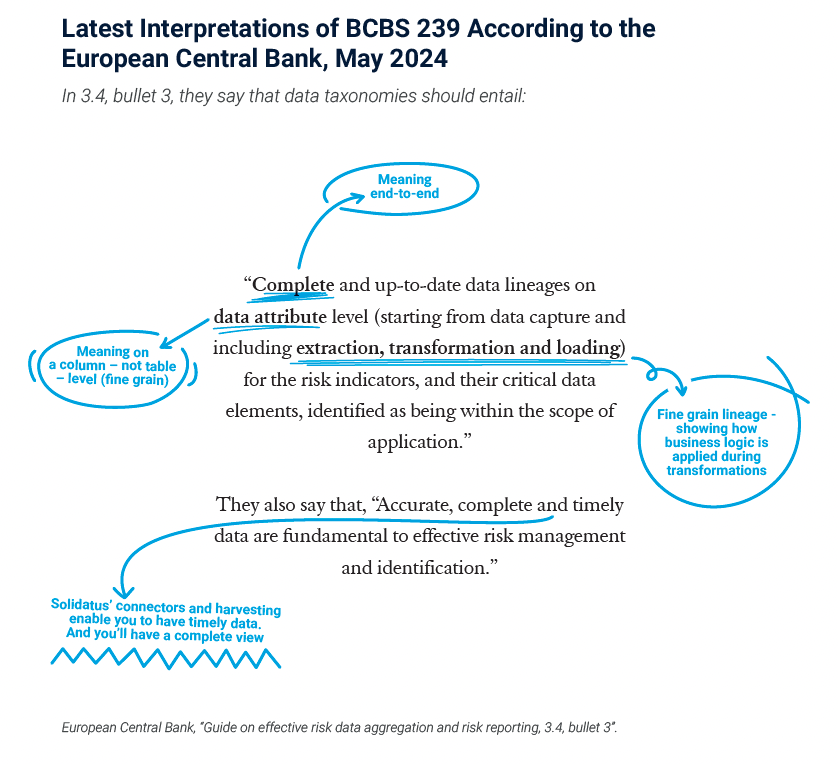
In May 2024, the ECB released its ‘Guide on effective risk data aggregation and risk reporting (RDARR)’...
Read why advanced data lineage is crucial for business success
An update on some recent developments in our latest product releases
Read more about data lineage and its business impact, including on AI, BCBS 239 and more
Navigate BCBS 239’s rigorous standards with advanced data lineage
Solidatus data lineage partners with Microsoft Purview to help enterprises trust their data

Read about the new Solidatus interface
Read our key takeaways from Gartner D&A Summit 2024

Video introducing our new interface and core features like Connected Catalog and Data Map
Read about Solidatus and Snowflake Horizon's governance solution
Explore the various aspects of data lineage and its crucial role in your organization.

Basel III is changing – are you prepared? Read 3 easy steps with Solidatus
Read how we helped successfully launched the Houston Women in Data Chapter

Exploring the parallels between urban planning and data planning projects

71% of senior data leaders in financial services polled are close to quitting their jobs

Take a look at what's new in our partnership with Snowflake

VP Product, Tina Chace, reflects on the Gartner conference, covering data governance and AI

We’ve linked the Eurovision Song Contest to the realm of data governance and data lineage

In the latest Gartner® research note, find out what active metadata is

The role of metadata, dynamic visualization and inference across metadata

Automatic connectors are essential for efficiently mapping metadata but not all are created equal. We look at the most important...

We discuss injecting active metadata into your governance and 4 other things we’re looking forward to at the Gartner® Data...