





































What to look for in a data lineage platform

A buyer’s guide to choosing the foundation of your AI stack.
Every AI initiative runs on the company’s own data. The models, agents, and copilots all draw on enterprise systems, and most AI-governance tooling treats that data as trustworthy because it came from inside the business. Anyone who has run a data quality program knows that assumption rarely holds. Data lineage is the part of the AI stack that settles the question, tracing where each value came from, how it changed, and whether it can be trusted before a model acts on it. Gartner now frames trusted, granular lineage as foundational to managing the risks of agentic AI.1
That puts lineage in table-stakes territory. Nearly every catalog, governance suite, and pipeline tool now lists it on the datasheet, and AI has made automated capture faster than ever. Automation only reaches so far, though. Scanners stop at systems they cannot read, bespoke code resists extraction, and the business meaning behind a flow still needs a person who can see the map and work the hard cases by hand. So the buyer’s question runs deeper than whether a tool claims lineage. Which platform can maintain its role in your AI stack as data changes faster than people can track it, remain navigable when automation reaches its limits, and survive the moment a CIO asks why the team cannot just build it in-house? The following criteria explain how to tell.
The checklist most teams inherited was written for a static world. It asks how many connectors a tool ships, how much of the data estate it covers, and whether the lineage diagram looks clean in a demo. Those questions still matter, but they score lineage as documentation, a picture of how data moved, read only when someone goes looking. In an AI stack, that picture is outdated the moment an agent or a pipeline changes the data, and a stale map is worse than none, because people still trust it. Gartner describes the change the same way, as metadata moving from a passive log to an active orchestration layer.2
Three patterns should take a platform off the list:
Each one leaves you with a record of the past, when an AI stack needs lineage that can show what a proposed change will do before it reaches production. That line, between documenting history and modeling change, runs through every criterion that follows.
A lineage platform earns its place in the AI stack only if it can follow a value across the whole data estate, from the source system through every transformation to the report or model that consumes it, at the column level. Hybrid, multi-cloud, and legacy systems all belong in the same trace. Automated scanning handles most of the work, but the hard cases still need help. Bespoke code, undocumented feeds, and the mainframe no scanner can read call for precision modeling and a visual map a person can explore and extend. Coverage that dead-ends at the first system it cannot reach leaves a partial map, with a blind spot exactly where the risk tends to hide.
Ask a vendor to trace one critical data element from source to policy to consumption across a system that their scanner cannot read. A platform built for the AI stack shows the full path and allows an analyst to complete the trace in the visual model. A scan-only tool stops at the wall.
Depth at scale is the proof. At HSBC, two people modeled the entire wholesale credit and lending book in under six months, across 2,000 source tables, more than 80,000 fields, and 45 source systems on one model.3 Reaching that far takes automated capture paired with a visual lineage map, the Solidatus approach to the systems a scanner alone cannot crack.
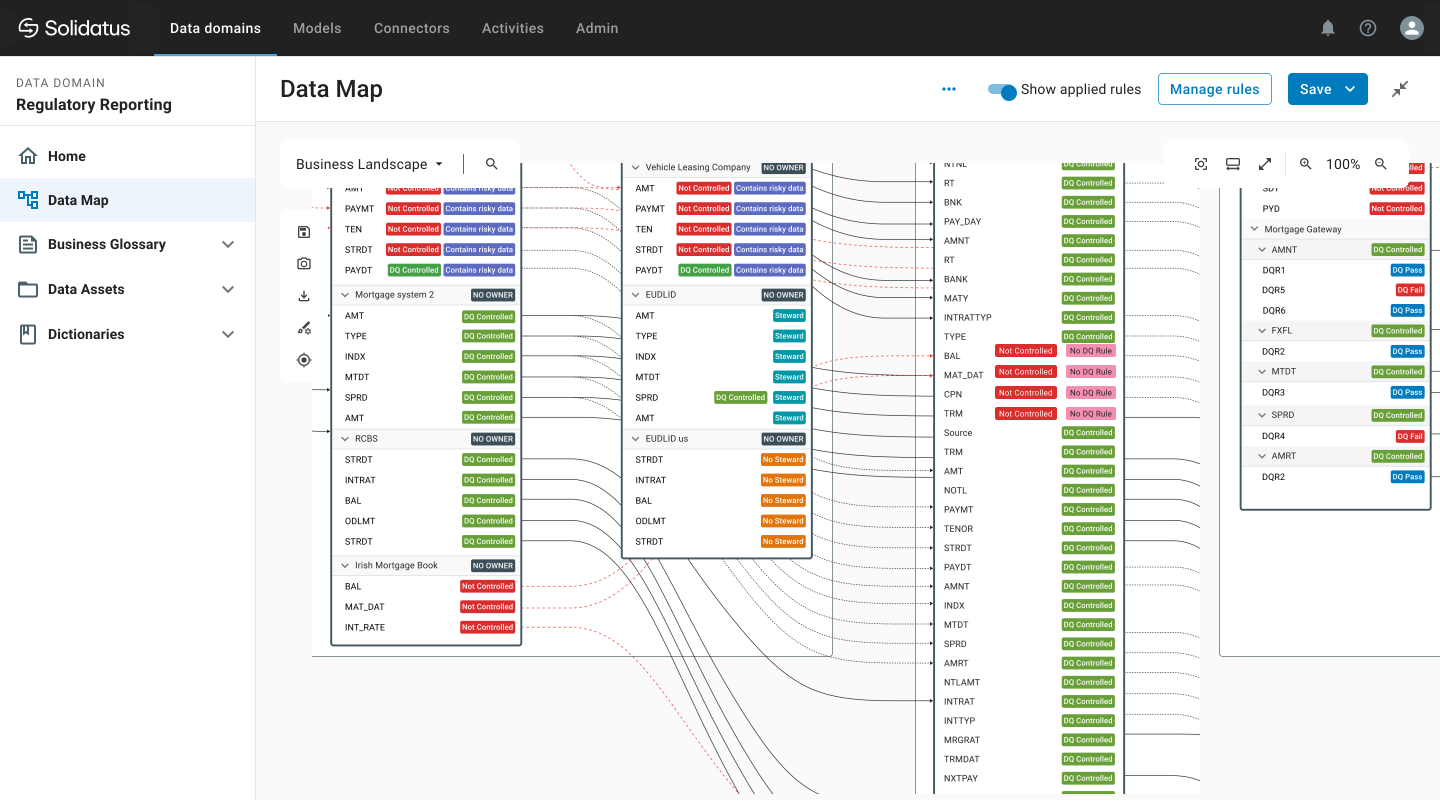
Technical lineage tells you how data moves. It cannot tell you what the data means, who is accountable for it, or whether regulatory obligations apply, and those are the questions an AI stack raises first. When a field feeds a credit model, it carries more than an upstream source. It has an owner, a risk rating, a regulatory tag, and a lineage platform worth buying, which holds all of that alongside the technical path. The shorthand is the difference between a library card and a blueprint. A library card confirms a record exists; a blueprint shows how it was built and what it is for.
To test it, pick one field that feeds into an AI model or a regulatory report, and ask the vendor to show, in a single view, which business process it serves, who owns it, and which regulatory obligations it touches. A platform with real business context answers on screen. A technical-only tool sends you to a second system or a spreadsheet.
RLAM mapped more than 175,000 fields and 99,000 data-attribute flows across 41 source systems for a £162.3bn book, and linked the physical data back to catalogs and business meaning.4 At BNY, a data risk usage board reviews how data and AI will be used before work begins, the same governance foundation now carries its AI deployment.5 In each case, lineage holds the business meaning alongside the technical schema.
Most governance work has always been manual. Someone tags critical data elements, links glossary terms to them, and chases the flows that have no lineage at all. It is slow, perpetually behind, and the first thing to lapse when a team is stretched. The next generation of lineage platforms hands that tedium to agents that watch the model and act on what they find, from a simple alert to a suggested fix to an applied one under review. The most useful version warns a developer that a change will break a downstream report before it reaches production, rather than documenting the breakage 30 days later. Gartner calls this active metadata and treats it as a requirement for keeping data governable as AI moves through the data estate. The same research reports that automated lineage can cut banking data-quality audit times from weeks to hours.6
Every vendor will ship agents, so having them proves little. Watch what happens when an agent edits your lineage. On a scan-and-catalog tool with no underlying version control, an AI-generated change is noise into the void, with no clean way to see what it altered or to undo it. A version-controlled lineage model handles that by construction. You can compare any two points in time; the bi-temporal record an auditor needs shows the data’s state at the time a decision was made. Then model a proposed change in a sandbox and accept or reject it through a git-like review.
Look for agents who author and edit the lineage model itself, with every change recorded as a reviewable version. Many assistants only read the model; the ones who can safely change it are rarer. Gartner makes the same point. Because AI agents both create and consume data, lineage needs safeguards like automated quality scoring and validation before a change lands.7
In a demo, have an agent change the lineage in front of you, then review and roll it back. One anonymized bank cut a BCBS 239 assessment from months to minutes and stood up its first auto-updating data dictionary.8 An asset management firm reduced governance costs by 60% and now makes decisions in minutes that once took months.9 Both turn lineage into an operational asset that keeps pace with change.
When any single feature can be rebuilt with a prompt, the longest feature list is the wrong scorecard. A broad governance suite can add a lineage capability in a release. It cannot reorganize an entire platform around lineage, because that is a matter of identity rather than a roadmap item. A competitor can prompt-build a lineage feature overnight. It cannot prompt fifteen years of focus on the problem. So the durable question is whether lineage is what the vendor is, or one module among twenty that it maintains.
That focus also keeps a vendor honest about scope. Gartner is explicit that no single vendor handles all of AI governance, so treat any vendor that claims to cover all of it with caution.10 A credible vendor takes a narrower, stronger posture. It is the trusted data foundation that the rest of the AI stack depends on, and it integrates with the runtime tools that monitor agents rather than claiming to replace them.
Two questions expose it. What share of the vendor’s engineering goes to lineage, and how does the platform work with runtime AI governance tools rather than against them? The answers separate a company that lives in lineage from one that treats it as a checkbox.
Every evaluation reaches this question, often from a CIO at sign-off who already owns a broad platform and wants no new tools. It deserves a straight answer. A prompt can generate a lineage feature in an afternoon. The harder parts take years to build and longer to trust. They are the accumulated context behind a mature model, the version-controlled architecture that keeps change safe, and the steady work of keeping lineage reviewed and current as the environment moves. That experience comes from solving lineage for some of the largest and most complex organizations in the world, across many data governance environments rather than one, and it is not in your LLM’s training data. Internal agents pointed at the problem without that foundation tend to produce modern legacy, AI-written pipelines no one can unpick once the person who wrote the prompt has moved on. The engines that survive this era are the ones hardest to rebuild, so evaluate the engine underneath.
Turn the four criteria into four questions for every vendor on your shortlist, and weight the answers toward the ones a generic platform cannot fake:
Score each vendor against all four with the data lineage platform evaluation scorecard, then put your two finalists through the active-lineage test on your own data in a Solidatus demo. A platform that answers all four on its own can anchor your AI stack. One that sends you elsewhere for any of them is only documenting it.
[1]De Simoni, Guido. “Data Lineage Is Essential to Manage the Risks of Agentic AI.” Gartner, March 24, 2026. ID G00847339.
[2]De Simoni, Guido. “Data Lineage Is Essential to Manage the Risks of Agentic AI.” Gartner, March 24, 2026. ID G00847339.
[3]Solidatus customer reference (HSBC). Sid Mubashar, Head of Wholesale Credit and Lending Data, HSBC, on the record.
[4]Solidatus customer reference (Royal London Asset Management). Lynn Watts, Head of Data Management and Governance, RLAM, on the record.
[5]Solidatus customer reference (BNY). Eric Hirschhorn, Chief Data Officer, BNY, on the record.
[6]De Simoni, Guido. “Data Lineage Is Essential to Manage the Risks of Agentic AI.” Gartner, Ma rch 24, 2026. ID G00847339.
[7]De Simoni, Guido. “Data Lineage Is Essential to Manage the Risks of Agentic AI.” Gartner, March 24, 2026. ID G00847339.
[8]Solidatus customer reference (global investment bank, anonymized): automated BCBS 239 lineage assessment.
[9]Solidatus customer reference (asset management firm, anonymized).
[10]Gartner. “Market Guide for AI Governance Platforms.” 2025.
01.
A data lineage platform traces data across an organization at the column level, from its source system through every transformation to the report or model that consumes it. In the AI era, it serves as the trusted data layer of the AI stack, indicating where data came from, what it means, and whether it can be trusted before a model acts on it. The strongest platforms pair automated capture with a visual model an analyst can extend, and record every change as a reviewable version.
02.
A data catalog inventories data assets and helps people find them. A data lineage platform shows how data flows and changes between systems. Catalogs often include a lineage view, but it tends to be a byproduct of cataloging that stops at the table level. A dedicated lineage platform traces column-level paths end-to-end. It links each flow to its business meaning, ownership, and regulatory relevance – the details a regulator or an AI model depends on.
03.
AI governance tools often assume enterprise data is trustworthy because it comes from within the business, but that assumption rarely holds. Data lineage provides evidence by showing the provenance of the data feeding a model, flagging when a change will affect downstream outputs, and allowing auditors to reconstruct what the data looked like when a decision was made. Gartner frames trusted, granular lineage as foundational to managing the risks of agentic AI.
04.
Score each vendor on four criteria. First, complete the lineage that runs end-to-end at the column level across hybrid, multi-cloud, and legacy systems. Second, business context that links flows to ownership, risk, and regulation. Third, active lineage, where agents keep the model current and a version-controlled foundation makes their changes reviewable. Fourth, focus: meaning, the vendor’s core rather than one module in a broad suite. A platform that answers all four on its own can anchor your AI stack.
05.
A prompt can quickly generate a lineage feature, but the durable parts take far longer to build and trust. They include the accumulated, governed context behind a mature model, a version-controlled architecture that keeps change safe, and the operational work of keeping lineage current in production. Internal agents without that foundation tend to create “modern legacy,” AI-written pipelines no one can unpick once the author moves on. Evaluate the engine underneath, because that is the hard part to rebuild.
06.
Version-controlled, bi-temporal lineage treats the lineage model like source code. You can compare any two points in time, model a proposed change in a sandbox before production, and accept or reject it through a git-like review. The bi-temporal record lets an auditor reconstruct the data’s state at the moment a decision was made. This architecture makes AI-driven change safe because every edit can be reviewed, traced, and rolled back.
Published on: August 11, 2026

What your data lineage has to prove before an examiner asks about a past decision
What runtime capture reaches, and what you have to model yourself.

Why a residency commitment is not evidence of custody.

Why data governance programs fail

Three criteria that make regulatory data lineage reusable

How data lineage brings assessment discipline to financial services data flows
Pre-change impact analysis for data estates that feed AI

What BCBS 239 and SR 26-2 now demand at the column level

MCP support, Bring Your Own LLM, and an assistant that keeps its context

Bi-temporal data lineage is the foundation of forensic AI investigation

Why an AI use policy cannot enforce itself.

How LSEG turned data lineage into a strategic asset for AI trust
What regulators expect when they ask you to prove data lineage

Why catalog-first tools fall short when regulators ask how your training data moved

When an AI model starts producing unexplainable results, the first instinct is to blame the model. Teams often rush to...

Five data lineage myths that the masterclass got right

What regulators are already asking about your AI, and what it takes to respond
Three questions your AI governance approach must answer

Three institutions receive the same question during Model Risk Management reviews: “Walk us through the complete data lineage for your...
Solidatus’ Tina Chace and fellow experts reveal why 90% of AI model failures trace back to upstream data changes

AI-ready data lineage is a comprehensive, auditable record of how data flows through your organization, designed to support AI governance...

In May 2024, the ECB released its ‘Guide on effective risk data aggregation and risk reporting (RDARR)’...
Read why advanced data lineage is crucial for business success
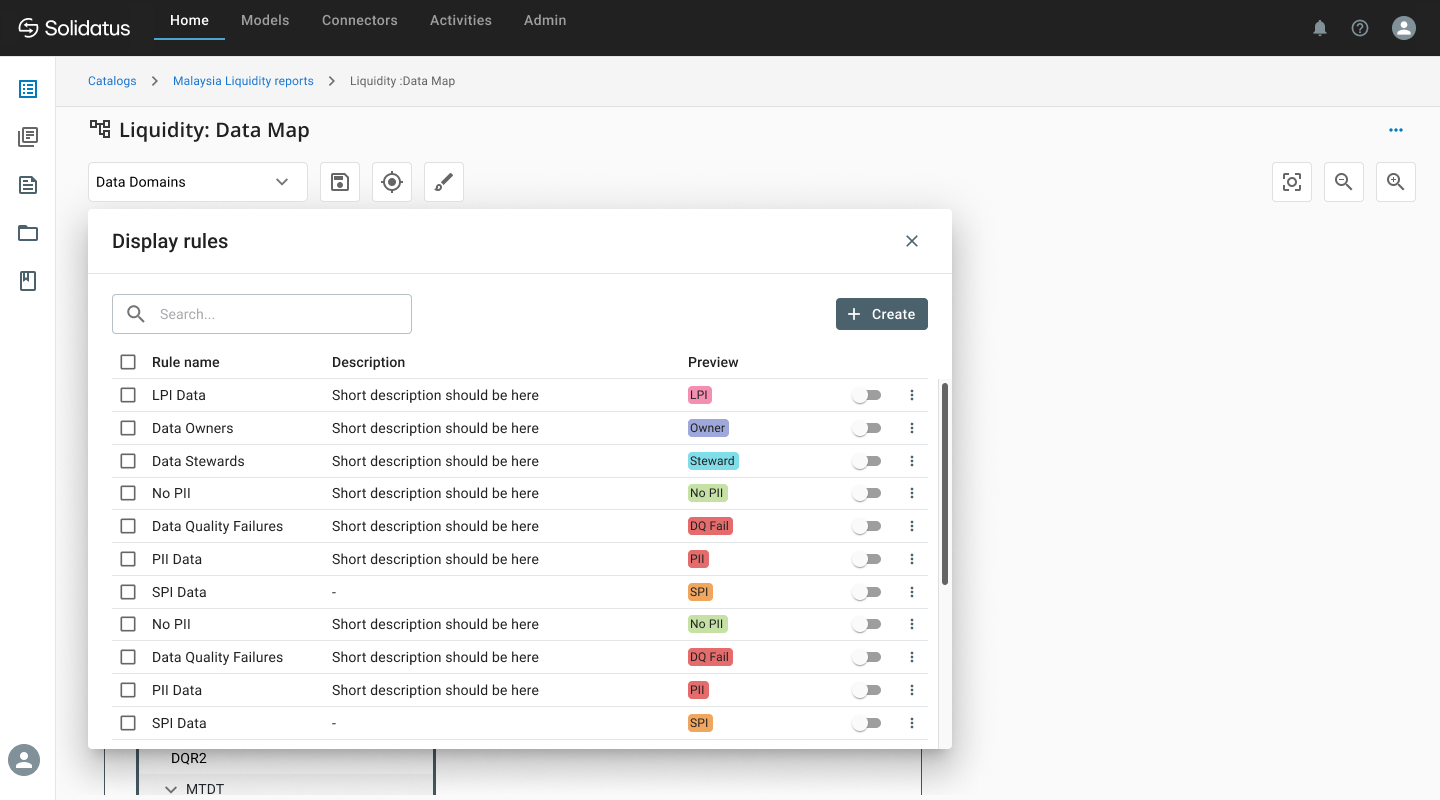
An update on some recent developments in our latest product releases
Read more about data lineage and its business impact, including on AI, BCBS 239 and more
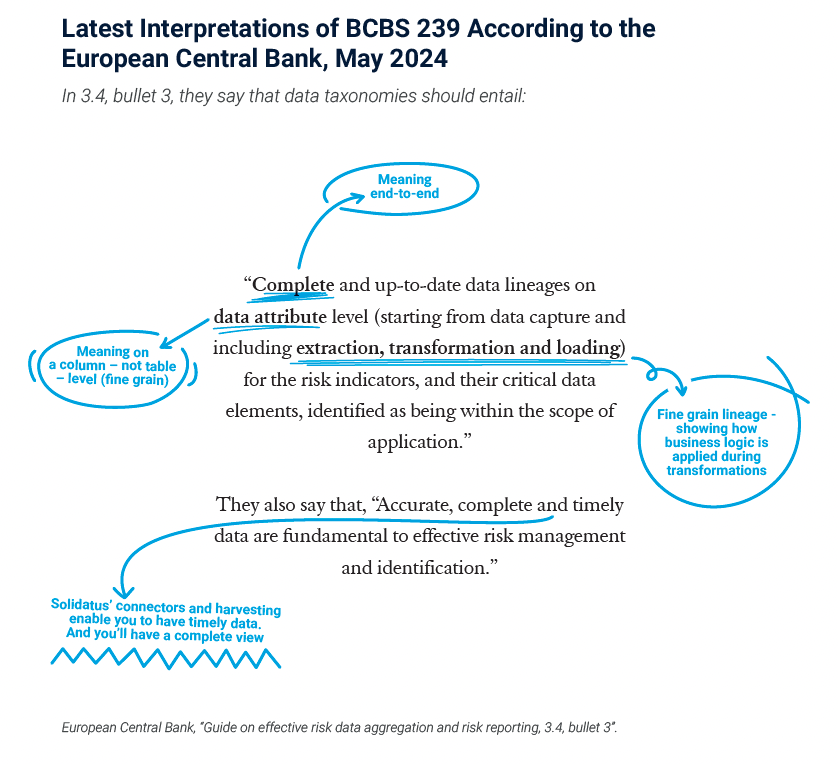
Navigate BCBS 239’s rigorous standards with advanced data lineage
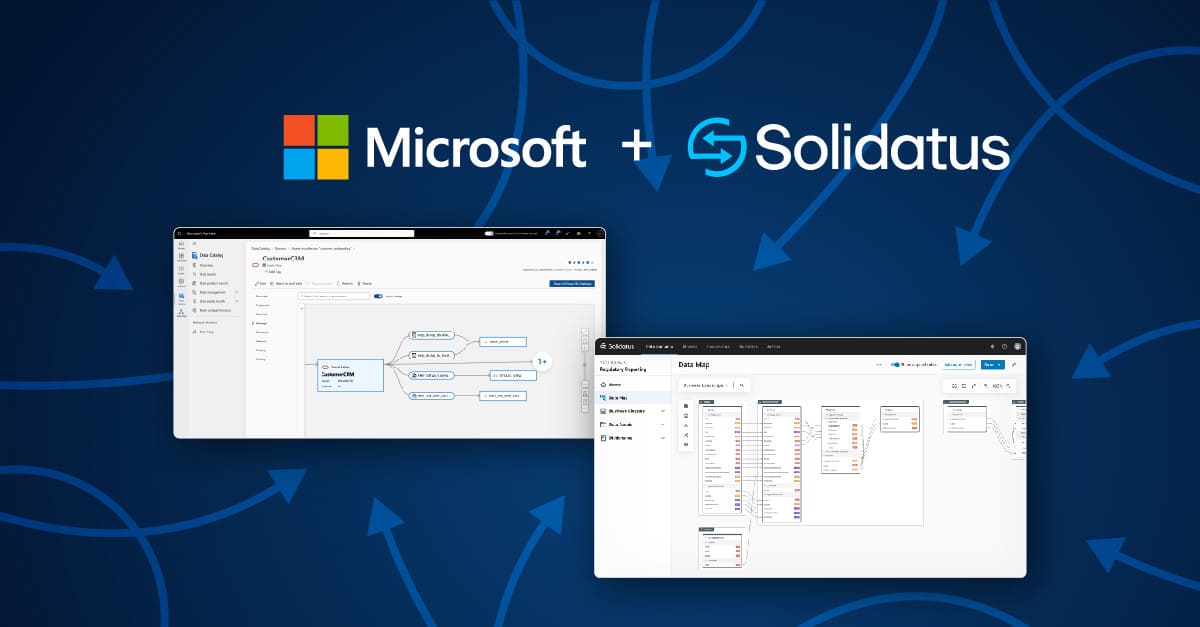
Solidatus data lineage partners with Microsoft Purview to help enterprises trust their data

Read about the new Solidatus interface
Read our key takeaways from Gartner D&A Summit 2024

Video introducing our new interface and core features like Connected Catalog and Data Map
Read about Solidatus and Snowflake Horizon's governance solution
Explore the various aspects of data lineage and its crucial role in your organization.
Basel III is changing – are you prepared? Read 3 easy steps with Solidatus
Read how we helped successfully launched the Houston Women in Data Chapter

Exploring the parallels between urban planning and data planning projects

71% of senior data leaders in financial services polled are close to quitting their jobs

Take a look at what's new in our partnership with Snowflake

VP Product, Tina Chace, reflects on the Gartner conference, covering data governance and AI

We’ve linked the Eurovision Song Contest to the realm of data governance and data lineage

In the latest Gartner® research note, find out what active metadata is

The role of metadata, dynamic visualization and inference across metadata

Automatic connectors are essential for efficiently mapping metadata but not all are created equal. We look at the most important...

We discuss injecting active metadata into your governance and 4 other things we’re looking forward to at the Gartner® Data...