








































Your AI context layer cannot tell you what it said in March

What your data lineage has to prove before an examiner asks about a past decision
Gartner now advises data and analytics leaders to “establish a context layer as a core component of their D&A infrastructure,” because schema-based data models on their own lack the business context and data meaning that AI agents need.1 Governance and data platform vendors have answered with a run of products and definitions built on the same phrase. In the sense most of them use, an enterprise context layer is the set of business definitions, ownership and policy records, and data lineage that an AI agent reads before it answers a question or takes an action. Agents without that context guess, so the demand behind the category is well founded.
Little of the published material addresses one question, and a model risk validator or bank examiner will eventually ask it. When an agent made a decision on a specific day in March, what did its context say on that day? Every definition in a context layer, along with the owner, policy, and lineage attached to it, was true as of some date. A context layer that keeps only the latest version of each can tell you what the business believes now, and it cannot show you what the agent was given.
The context an AI agent consumes is a collection of facts that change on their own schedules. A data steward revises the definition of a customer segment after a product launch, and a reorganization moves ownership of a risk dataset to another team. Policies get re-approved with new retention rules, and platform migrations replace the golden source behind a regulatory report, which reroutes the lineage path that feeds it. None of these changes is unusual, and a large bank makes several of them every week.
Each fact in that collection also has two dates. One is when the fact was true in the business, such as a segment definition that applied from January 1, and the other is when the organization recorded it, such as the day in September when a steward entered a corrected version. The two dates match when everything goes to plan, and they diverge whenever someone corrects an error after the fact, which is the situation an audit tends to probe. Data architects call storing both dates for every change bi-temporal storage. It lets a lineage platform answer two different questions about March 14: what the bank believed was true on that day, and what the bank now knows was true on that day. Most context layers are built around retrieving the current answer, and an edit log, where one exists, records only that something changed. Rebuilding the March state from that log means replaying edits by hand across every definition, ownership record, and lineage path the agent touched, and hoping that nothing was changed outside the tool.
An illustrative case shows how this plays out. A bank deploys an AI agent that answers credit exposure questions for relationship managers. The agent draws on its context layer for the definition of “small business customer,” for the policy that sets exposure limits for that segment, and for the lineage that shows which source systems feed the exposure figures.
In September, a data steward notices that the segment definition wrongly excludes sole proprietors, corrects it, and records the change. The same month, a platform migration swaps the golden source for customer turnover data, and the lineage behind the exposure figure now runs through a new system. Both changes are good governance, and nobody reviewed either one against the decisions the agent had already made.
In November, an examiner selects an exposure recommendation the agent made in March and asks the bank to show what the agent relied on. The model risk validator opens the context layer and finds September’s definition, the current lineage path, and the policy as approved today. An edit history confirms the definition changed, but it cannot show that definition alongside the owner, policy, and lineage it had on the day of the decision. The validator spends days rebuilding March from change tickets, email threads, and a migration runbook, and the result still depends on the memories of the people who made the changes. The stewardship that improved the context layer also erased the evidence the examiner asked for. The same problem appears one level down, at the model itself, where lineage tools forget what your AI model saw when it made a prediction.
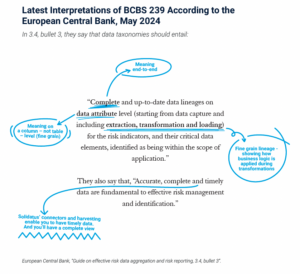
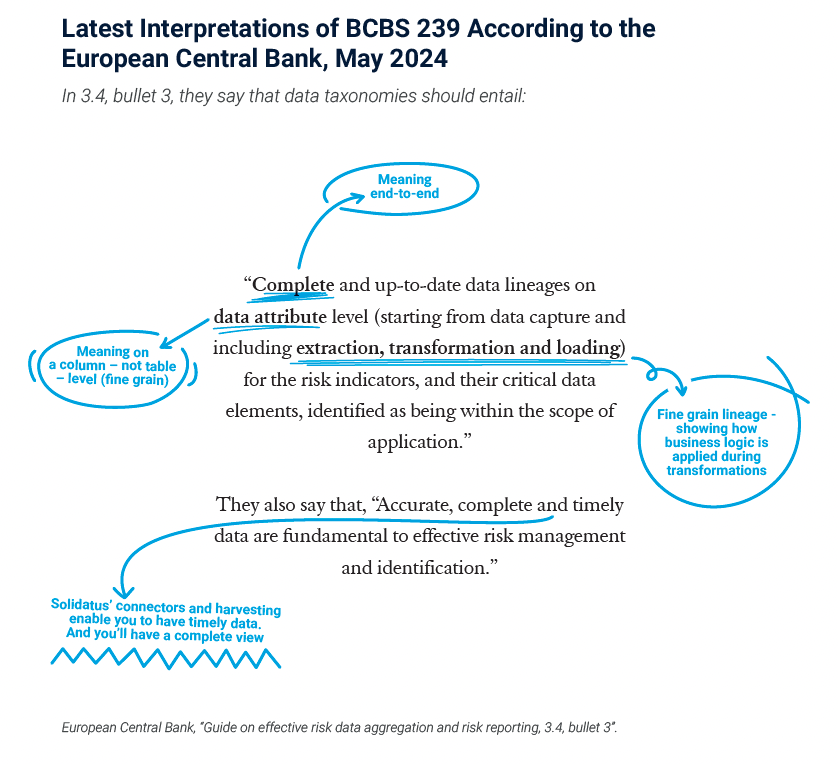
None of the major supervisory texts use the phrase “context layer.” The European Central Bank’s (ECB) May 2024 guide on effective risk data aggregation and risk reporting (RDARR), which builds on the BCBS 239 principles, expects banks to maintain “complete and up-to-date data lineages on data attribute level.”2 The guide also defines data lineage by what it lets a bank do, including the ability to “track back the source of the issue in a timely manner” after a data quality incident and to “allow traceability for (external) validation.”3 Both uses look backward. A validator tracing an incident needs the lineage as it stood when the incident occurred, and a lineage record kept up to date by overwriting its own history cannot provide it.
In the United States, SR 26-2, the April 2026 model risk management guidance from the Federal Reserve, the Federal Deposit Insurance Corporation, and the Office of the Comptroller of the Currency, places generative and agentic AI outside its scope. A footnote adds that a bank’s “risk management and governance practices should guide the determination of appropriate governance and controls” for the tools the guidance does not cover.4 Agents therefore answer to the governance expectations a bank already holds, including the lineage traceability the ECB guide spells out. Gartner points the same way, expecting that “regulators will demand greater semantic transparency.”5 Evidence also loses value as the underlying data changes, a problem your BCBS 239 evidence expires the day you file it examines in detail.
A context layer that an examiner can rely on needs three capabilities, and each one depends on keeping both dates for every change:
Solidatus is a data lineage platform built on this model. Its lineage model keeps both dates for every change, so teams can compare any two points in time and reconstruct the lineage model as it stood on a past date. Every change, including one drafted by the AI Lineage Assistant, goes through a review workflow of forks, comparisons, and pull requests before it reaches the production lineage model. Lineage from catalogs, data platforms, and legacy systems sits in one model alongside the business definitions, owners, and policies attached to it.
You can run this test on your own context layer this quarter in three steps:
An examiner’s questions about agentic AI go further than a single decision. The six audit questions agentic AI will force banks to answer set out the full chain of evidence, from the data an agent accessed to the reconstruction of any decision on demand, along with what your lineage architecture needs to answer each question.
01.
An enterprise context layer is the set of business definitions, ownership and policy records, and data lineage that an AI agent reads before it answers a question or takes an action. Gartner advises data and analytics leaders to make it a core part of their infrastructure, because schema-based data models alone lack the business meaning agents need. For regulated banks, a context layer must also serve as evidence, which means it must show what each definition, and the records attached to it, said on any past date.
02.
An examiner or model risk validator may select a decision an AI agent made months ago and ask what the agent relied on. Definitions, ownership and policy records, and lineage paths all change over time, often through routine corrections. When the context layer keeps only the latest version, the bank cannot show the state the agent used, and the validator has to rebuild it by hand from tickets and emails. Point-in-time history makes that past state something the bank can retrieve and compare.
03.
Bi-temporal storage records two dates for every change in a data lineage model: when a fact was true in the business, and when the organization recorded it. The two differ whenever someone corrects an error after the fact. Keeping both lets a lineage platform answer what the bank believed on a given day and what it now knows was true then, which is the foundation for comparing any two points in time and reconstructing past decisions.
04.
The ECB’s May 2024 guide on risk data aggregation and risk reporting expects “complete and up-to-date data lineages on data attribute level,” and it describes lineage as the means to track incidents back to their source and to allow traceability for external validation. Both purposes require the lineage as it stood when an event occurred. In the United States, SR 26-2 places agentic AI outside its scope but says a bank’s existing governance practices should determine its controls.
05.
Choose one AI-assisted decision from last quarter and one critical data element it used. Ask your context layer to reproduce that element’s definition exactly as it stood on the decision date, together with its owner, policy, and lineage in one view, and to show what has changed since. Then trace the element upstream until its lineage stops, because any reconstruction of a past decision ends at the same point.
[1]Gartner. “Gartner Says Lack of Semantics Causes Inaccurate AI Agents and Wasted Spending.” Press release, May 11, 2026.
https://www.gartner.com/en/newsroom/press-releases/2026-05-11-gartner-says-lack-of-semantics-causes-inaccurate-artificial-intelligence-agents-and-wasted-spending
[2]European Central Bank. “Guide on Effective Risk Data Aggregation and Risk Reporting.” ECB Banking Supervision, May 2024.
https://www.bankingsupervision.europa.eu/ecb/pub/pdf/ssm.supervisory_guides240503_riskreporting.en.pdf
[3]European Central Bank. “Guide on Effective Risk Data Aggregation and Risk Reporting.” ECB Banking Supervision, May 2024.
https://www.bankingsupervision.europa.eu/ecb/pub/pdf/ssm.supervisory_guides240503_riskreporting.en.pdf
[4]Board of Governors of the Federal Reserve System, Federal Deposit Insurance Corporation, and Office of the Comptroller of the Currency. “Supervisory Guidance on Model Risk Management.” SR Letter 26-2 Attachment, April 17, 2026.
https://www.federalreserve.gov/supervisionreg/srletters/SR2602a1.pdf
[5]Gartner. “Gartner Says Lack of Semantics Causes Inaccurate AI Agents and Wasted Spending.” Press release, May 11, 2026.
https://www.gartner.com/en/newsroom/press-releases/2026-05-11-gartner-says-lack-of-semantics-causes-inaccurate-artificial-intelligence-agents-and-wasted-spending
Published on: October 7, 2026
What runtime capture reaches, and what you have to model yourself.

Why a residency commitment is not evidence of custody.

Why data governance programs fail

Three criteria that make regulatory data lineage reusable

How data lineage brings assessment discipline to financial services data flows

A buyer's guide to choosing the foundation of your AI stack.

Pre-change impact analysis for data estates that feed AI

What BCBS 239 and SR 26-2 now demand at the column level

MCP support, Bring Your Own LLM, and an assistant that keeps its context

Bi-temporal data lineage is the foundation of forensic AI investigation

Why an AI use policy cannot enforce itself.

How LSEG turned data lineage into a strategic asset for AI trust

What regulators expect when they ask you to prove data lineage

Why catalog-first tools fall short when regulators ask how your training data moved

When an AI model starts producing unexplainable results, the first instinct is to blame the model. Teams often rush to...

Five data lineage myths that the masterclass got right

What regulators are already asking about your AI, and what it takes to respond
Three questions your AI governance approach must answer

Three institutions receive the same question during Model Risk Management reviews: “Walk us through the complete data lineage for your...

Solidatus’ Tina Chace and fellow experts reveal why 90% of AI model failures trace back to upstream data changes

AI-ready data lineage is a comprehensive, auditable record of how data flows through your organization, designed to support AI governance...

In May 2024, the ECB released its ‘Guide on effective risk data aggregation and risk reporting (RDARR)’...
Read why advanced data lineage is crucial for business success
An update on some recent developments in our latest product releases
Read more about data lineage and its business impact, including on AI, BCBS 239 and more
Navigate BCBS 239’s rigorous standards with advanced data lineage
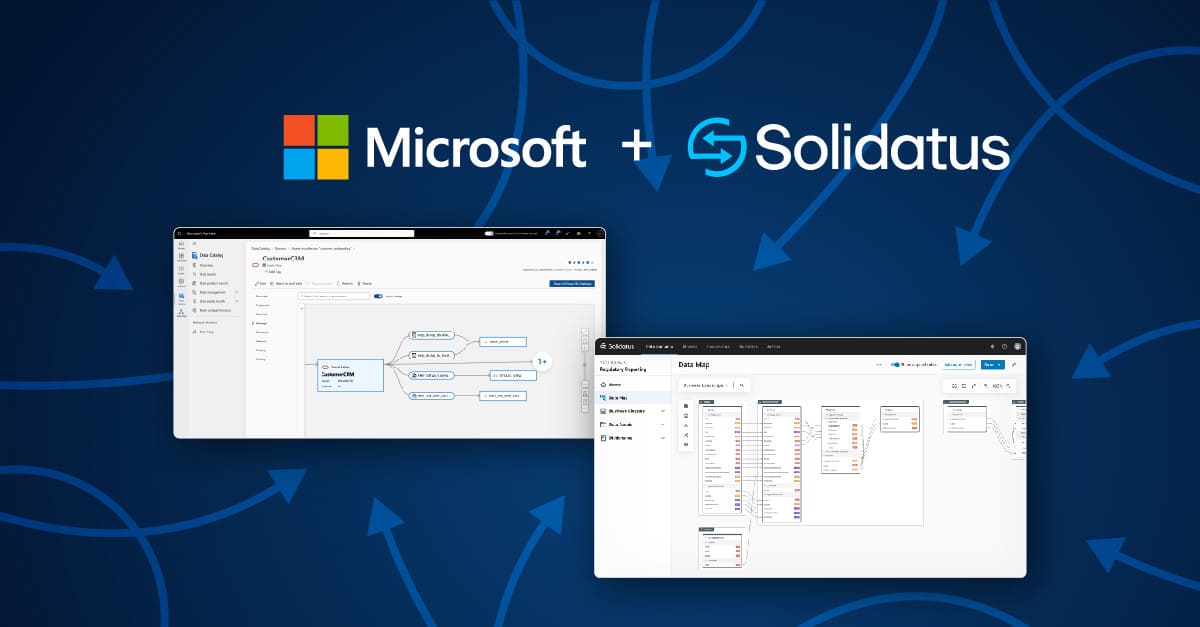
Solidatus data lineage partners with Microsoft Purview to help enterprises trust their data

Read about the new Solidatus interface
Read our key takeaways from Gartner D&A Summit 2024

Video introducing our new interface and core features like Connected Catalog and Data Map
Read about Solidatus and Snowflake Horizon's governance solution
Explore the various aspects of data lineage and its crucial role in your organization.

Basel III is changing – are you prepared? Read 3 easy steps with Solidatus
Read how we helped successfully launched the Houston Women in Data Chapter

Exploring the parallels between urban planning and data planning projects

71% of senior data leaders in financial services polled are close to quitting their jobs

Take a look at what's new in our partnership with Snowflake

VP Product, Tina Chace, reflects on the Gartner conference, covering data governance and AI

We’ve linked the Eurovision Song Contest to the realm of data governance and data lineage

In the latest Gartner® research note, find out what active metadata is

The role of metadata, dynamic visualization and inference across metadata

Automatic connectors are essential for efficiently mapping metadata but not all are created equal. We look at the most important...

We discuss injecting active metadata into your governance and 4 other things we’re looking forward to at the Gartner® Data...