






































A sovereign cloud does not make your data sovereign

Why a residency commitment is not evidence of custody.
Western European technology leaders are moving workloads toward local providers at scale. Gartner surveyed 241 chief information officers and information technology leaders across the region and found that 61% expect geopolitical factors to increase their reliance on local or regional cloud providers, while 53% said geopolitics will restrict their organizations’ future use of global cloud providers.1 Sovereign cloud capacity has moved out of policy discussion and into bank and insurer budgets.
Stanford’s Institute for Human-Centered Artificial Intelligence (HAI) examined what that money buys. Its July 2026 issue brief surveyed commercial sovereignty offerings across the technology stack, from Nvidia and Microsoft down to regional providers, and concluded that these offerings “often reconfigure, rather than eliminate, dependence” on the companies selling them.2
For regulated firms, that finding carries a narrower and more immediate consequence than the geopolitical one. A sovereign region settles where your infrastructure runs and which court holds jurisdiction over it. It cannot tell you which data crossed into that region, what permissions traveled with it, or who authorized the crossing. A supervisor asks those questions, and the answers live in records of what your firm did, which no provider’s architecture supplies.
Vendors that make sovereignty claims describe where the stack runs more than what it is built from, according to Stanford HAI’s survey. As the brief puts it, “the sovereignty claim, despite the scope of what the company is marketing, appears to focus less on the origin of the components and more on where the stack is deployed and under whose legal jurisdiction it operates.”3 Sovereign Australia AI sells compute, data centers, and applications built for Australian customers, and still runs on Nvidia chips.
Independent scrutiny of this market has barely begun, and the brief says as much. Whether these offerings deliver on their promises “or whether they simply rebrand existing dependencies to meet the moment, is a question that has increasingly been raised but has not been examined systematically.”4 Several initiatives have drawn criticism for what the authors call “sovereignty washing.”5
Stanford HAI notes that Microsoft and AWS, by committing to legally contest orders to suspend European services and to compensate customers for disclosures that violate the General Data Protection Regulation, “have implicitly (and, in some cases, explicitly) admitted that these ‘sovereignty overlays’ do not remove jurisdictional exposure to the United States.”
All three sovereignty tiers answer a question about location and legal authority over infrastructure, and they answer it from an engineering perspective. None observes what your business does with regulated data once it arrives. That second question is the one a regulatory agency will ask you to evidence, and it is answered from your own records or not at all.
Residency asks where data sits. Custody asks a harder question: who touched this data, when, and under what authority. A supervisor examining your firm will not audit your cloud provider’s sovereignty marketing, and a contractual residency commitment describes an intended state when an examiner wants an observed one. An earlier post in this series made a version of this case about AI use policies, which state a rule without observing whether anyone holds to it.
The Digital Operational Resilience Act (DORA) has been in force across European financial services since January 2025, and it asks custody questions throughout. Article 28 requires documented exit strategies for information and communication technology (ICT) arrangements that support critical or important functions. Article 30 sets out mandatory contractual provisions, including rights of access, inspection, and audit, with an enhanced set applying wherever a service supports a critical or important function.6 An audit right is exercised against records of what happened, not against an architecture diagram of where servers live.
Any firm that hoped the European Union’s AI Act would set the pace here got a reprieve, not relief. The Digital Omnibus on AI, which the Council adopted on June 29, 2026, deferred full compliance for standalone high-risk systems listed in Annex III from August 2, 2026 to December 2, 2027.7 Credit scoring and insurance pricing sit inside Annex III, so much of financial services AI now has sixteen additional months. DORA didn’t move at all, which means the obligation to prove where regulated data went and who was entitled to see it is already live and already being examined.
London Stock Exchange Group treated DORA as exactly this kind of obligation. The regulation was the stated trigger point for the group’s data lineage program, which began mapping datasets field by field in 2023.8 Operational resilience requirements moved a global market infrastructure firm to element-level lineage years before the AI rules arrived.
The brief’s prescription deserves more attention than its critique, and it translates directly to the enterprise. “The core policy challenge of AI sovereignty is not eliminating dependence but calibrating interdependence,” the brief argues. “Sovereignty should be viewed as the capacity to shape and negotiate dependencies, not avoid them entirely.”9
Capacity to negotiate presumes knowledge of what is being negotiated. A firm that cannot enumerate which regulated data reaches which provider, under which contractual obligation and which jurisdiction, has no position at the table regardless of what its master services agreement says. Concentration risk works the same way. DORA’s register of information, the inventory of ICT arrangements every firm keeps for its supervisor, exists because regulators want institutions to understand their own dependency structure, and a register assembled from procurement records describes what was bought, which is seldom what is running.
Few organizations will replace an entire data ecosystem with a sovereign region. The realistic destination is a mixed enterprise data environment, with public hyperscaler capacity, one or more sovereign regions, and air-gapped enclaves operating at the same time. Once that is the architecture, jurisdiction stops behaving like a property of a datacenter and starts behaving like an attribute attached to a data flow. Answering whether a particular customer record may move from the public region into the sovereign one, or out of it, requires knowing what that record is, which obligation governs it, and which downstream systems consume it.
At the enterprise level, Stanford HAI’s brief frames control in terms a chief risk officer will recognize: “Full control of your AI stack means you are not beholden to any one company that could withhold its capabilities at any moment.”10 For a European financial institution, that is not a philosophical position. DORA Article 28 already requires a documented exit strategy for any ICT arrangement supporting a critical or important function, and operational resilience is where that obligation is examined.11
To move a workload out of a provider, you have to know every downstream consumer of every flow that provider touches, including the reports, models, and regulatory submissions that would break on the way out. Firms that run this exercise find dependencies they never documented, which is why they should run it before an exit is forced on them.
Plan a migration of this kind as a model before running it as a project. A future-state model is a branch of a version-controlled data lineage graph representing a proposed change, which teams diff against production to see every affected consumer in advance. An earlier post on impact analysis covers how that works and what asset managers have learned from planning replatforming this way. The same discipline applies whether the destination is a sovereign region, a partner-operated cloud, or an exit from a provider that has become too concentrated to be comfortable.
Sovereignty programs tend to begin in procurement and stall when someone asks for evidence. Three pieces of groundwork are worth more than another vendor assurance, and each can begin ahead of the next contract renewal or migration:
None of this work requires resolving the geopolitics. It requires a firm to know its own data well enough to defend a sovereignty claim when someone asks for evidence.
Organizations that get this right treat sovereignty as an operational capability they run and evidence, not a box closed at procurement. They can show where regulated data flows, which obligations travel with it, and what would break if a provider became unavailable. Solidatus is a data lineage platform built for that work in regulated industries, combining end-to-end lineage with the business context that makes a data flow interpretable, and the AI Lineage Assistant extends it to the training data and outputs of AI systems now entering the same regulatory perimeter.
A sovereign cloud is a reasonable purchase, and for many regulated firms it is the correct one. It is not an answer to the question your supervisor will ask.
[1]Gartner. “Gartner Survey Reveals Geopolitics Will Drive 61% of CIOs and Information Technology Leaders in Western Europe to Increase Reliance on Local Cloud Providers.” Gartner, November 12, 2025. https://www.gartner.com/en/newsroom/press-releases/2025-11-12-gartner-survey-reveals-geopolitics-will-drive-61-percent-of-cios-and-information-technology-leaders-in-western-europe-to-increase-reliance-on-local-cloud-providers.
[2]Meinhardt, Caroline, Juan N. Pava, Caroline Yee, and James A. Landay. “Sovereignty for Sale: The Commercial Landscape of AI Sovereignty Offerings.” Stanford HAI Policy & Society, July 15, 2026. https://hai.stanford.edu/policy/the-commercial-landscape-of-ai-sovereignty-offerings.
[3]Meinhardt, Caroline, Juan N. Pava, Caroline Yee, and James A. Landay. “Sovereignty for Sale: The Commercial Landscape of AI Sovereignty Offerings.” Stanford HAI Policy & Society, July 15, 2026. https://hai.stanford.edu/policy/the-commercial-landscape-of-ai-sovereignty-offerings.
[4]Meinhardt, Caroline, Juan N. Pava, Caroline Yee, and James A. Landay. “Sovereignty for Sale: The Commercial Landscape of AI Sovereignty Offerings.” Stanford HAI Policy & Society, July 15, 2026. https://hai.stanford.edu/policy/the-commercial-landscape-of-ai-sovereignty-offerings.
[5]Meinhardt, Caroline, Juan N. Pava, Caroline Yee, and James A. Landay. “Sovereignty for Sale: The Commercial Landscape of AI Sovereignty Offerings.” Stanford HAI Policy & Society, July 15, 2026. https://hai.stanford.edu/policy/the-commercial-landscape-of-ai-sovereignty-offerings.
[6]European Parliament and Council of the European Union. “Regulation (EU) 2022/2554 on Digital Operational Resilience for the Financial Sector (DORA).” EUR-Lex, December 14, 2022. https://eur-lex.europa.eu/eli/reg/2022/2554/oj/eng.
[7]Council of the European Union. “Artificial Intelligence: Council Gives Final Green Light to Simplify and Streamline Rules.” Press release, June 29, 2026. https://www.consilium.europa.eu/en/press/press-releases/2026/06/29/artificial-intelligence-council-gives-final-green-light-to-simplify-and-streamline-rules/.
[8]Shibli, Aliya. “LSEG’s Journey from Regulation to Revenue through Data.” The Banker, September 25, 2025. https://www.thebanker.com/content/18fd41d8-f187-4b3e-81fa-534797e24f8f.
[9]Meinhardt, Caroline, Juan N. Pava, Caroline Yee, and James A. Landay. “Sovereignty for Sale: The Commercial Landscape of AI Sovereignty Offerings.” Stanford HAI Policy & Society, July 15, 2026. https://hai.stanford.edu/policy/the-commercial-landscape-of-ai-sovereignty-offerings.
[10]Meinhardt, Caroline, Juan N. Pava, Caroline Yee, and James A. Landay. “Sovereignty for Sale: The Commercial Landscape of AI Sovereignty Offerings.” Stanford HAI Policy & Society, July 15, 2026. https://hai.stanford.edu/policy/the-commercial-landscape-of-ai-sovereignty-offerings.
[11]European Parliament and Council of the European Union. “Regulation (EU) 2022/2554 on Digital Operational Resilience for the Financial Sector (DORA).” EUR-Lex, December 14, 2022. https://eur-lex.europa.eu/eli/reg/2022/2554/oj/eng.
01.
No. A sovereign cloud region settles where infrastructure runs and which legal jurisdiction governs it, which is a location question. It does not record which regulated data entered that region, what permissions traveled with it, or who authorized the movement. Stanford HAI’s July 2026 survey of commercial sovereignty offerings found that they often reconfigure, rather than eliminate, dependence on the providers selling them. Evidence of data custody comes from a firm’s own records of its data flows, not from a provider’s architecture.
02.
Data residency describes where data physically sits and which laws apply in that location. Data custody describes who touched a given data element, when, and under what authority. A residency commitment in a cloud contract states an intended arrangement. A custody question is answered from records of what happened inside your data environment, which is what a financial supervisor exercising audit rights under the Digital Operational Resilience Act (DORA) will ask a firm to produce.
03.
The Digital Operational Resilience Act (DORA) has applied across European financial services since January 2025. Article 28 requires financial entities to maintain documented exit strategies for information and communication technology (ICT) arrangements supporting critical or important functions. Article 30 sets mandatory contractual provisions, including rights of access, inspection, and audit, with enhanced requirements where a service supports a critical or important function. Testing an exit strategy means tracing every downstream consumer of the data that the provider holds.
04.
No. The Digital Omnibus on AI, adopted by the Council of the European Union on June 29, 2026, deferred full compliance for standalone high-risk AI systems listed in Annex III from August 2, 2026 to December 2, 2027. Credit scoring and insurance pricing fall inside Annex III, so a large share of financial services AI gained sixteen months. DORA was not amended and continues to apply, so obligations to evidence data flows and access authority remain live.
05.
Data lineage records where regulated data originates, how it moves between systems, and which downstream reports, models, and regulatory submissions consume it. When jurisdiction and contractual obligations attach to the data flow instead of a system inventory, a firm can answer at the attribute level which data may enter a sovereign region and which may not. That same record supports concentration risk assessment and the exit testing DORA Article 28 requires.
06.
Stanford HAI’s July 2026 issue brief groups commercial sovereign cloud offerings into three tiers. Hyperscaler-operated clouds add sovereignty controls such as data residency limits, confidential computing, and customer-held encryption keys. Partner-operated clouds place a national entity in control of infrastructure and administrative access, creating a jurisdictional shield against extraterritorial requests. Disconnected and air-gapped clouds serve defense and critical infrastructure. The brief notes that Microsoft and AWS have implicitly admitted the first tier does not remove US jurisdictional exposure.
Published on: September 17, 2026

What your data lineage has to prove before an examiner asks about a past decision
What runtime capture reaches, and what you have to model yourself.

Why data governance programs fail

Three criteria that make regulatory data lineage reusable

How data lineage brings assessment discipline to financial services data flows

A buyer's guide to choosing the foundation of your AI stack.

Pre-change impact analysis for data estates that feed AI

What BCBS 239 and SR 26-2 now demand at the column level

MCP support, Bring Your Own LLM, and an assistant that keeps its context

Bi-temporal data lineage is the foundation of forensic AI investigation

Why an AI use policy cannot enforce itself.

How LSEG turned data lineage into a strategic asset for AI trust
What regulators expect when they ask you to prove data lineage

Why catalog-first tools fall short when regulators ask how your training data moved

When an AI model starts producing unexplainable results, the first instinct is to blame the model. Teams often rush to...

Five data lineage myths that the masterclass got right

What regulators are already asking about your AI, and what it takes to respond
Three questions your AI governance approach must answer

Three institutions receive the same question during Model Risk Management reviews: “Walk us through the complete data lineage for your...

Solidatus’ Tina Chace and fellow experts reveal why 90% of AI model failures trace back to upstream data changes

AI-ready data lineage is a comprehensive, auditable record of how data flows through your organization, designed to support AI governance...

In May 2024, the ECB released its ‘Guide on effective risk data aggregation and risk reporting (RDARR)’...
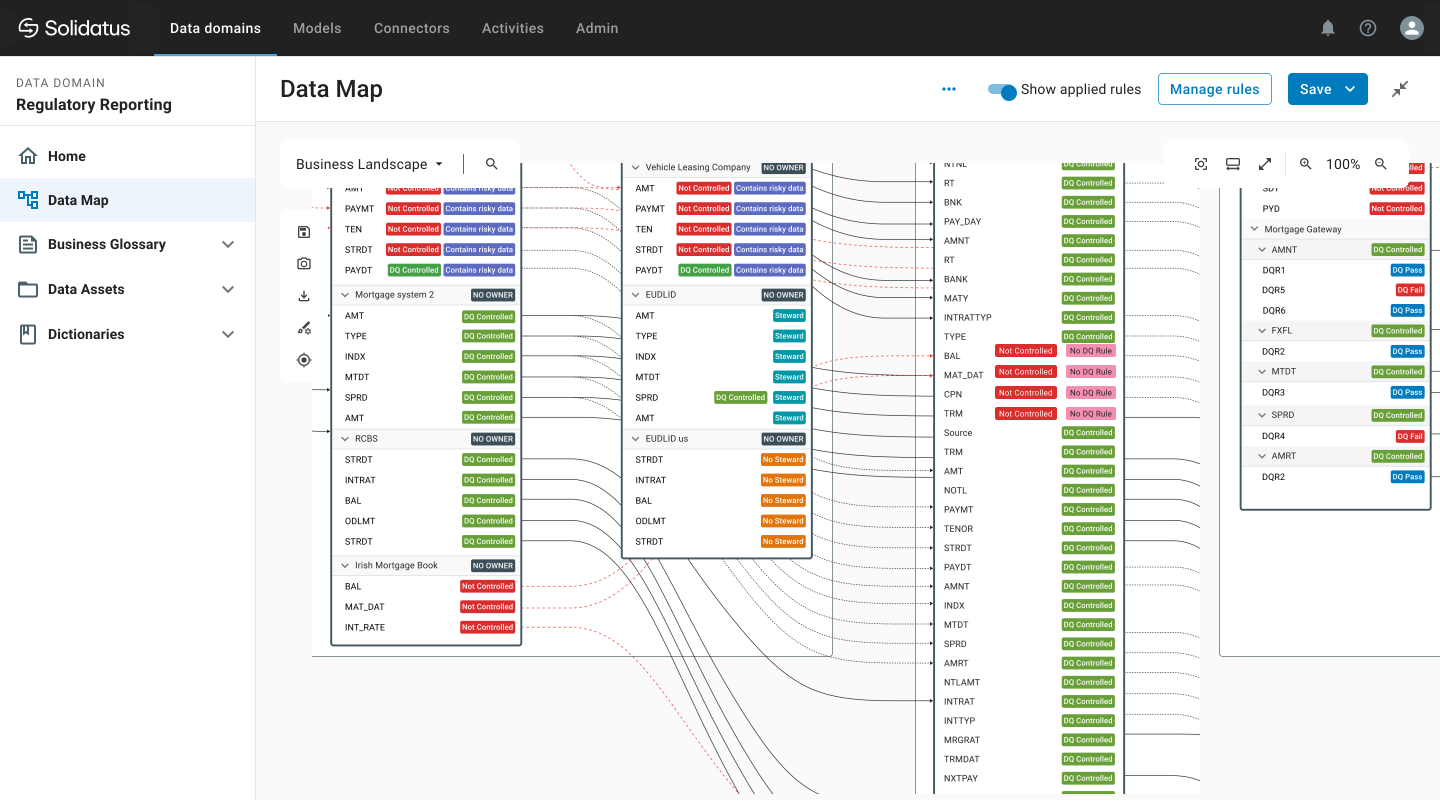
Read why advanced data lineage is crucial for business success
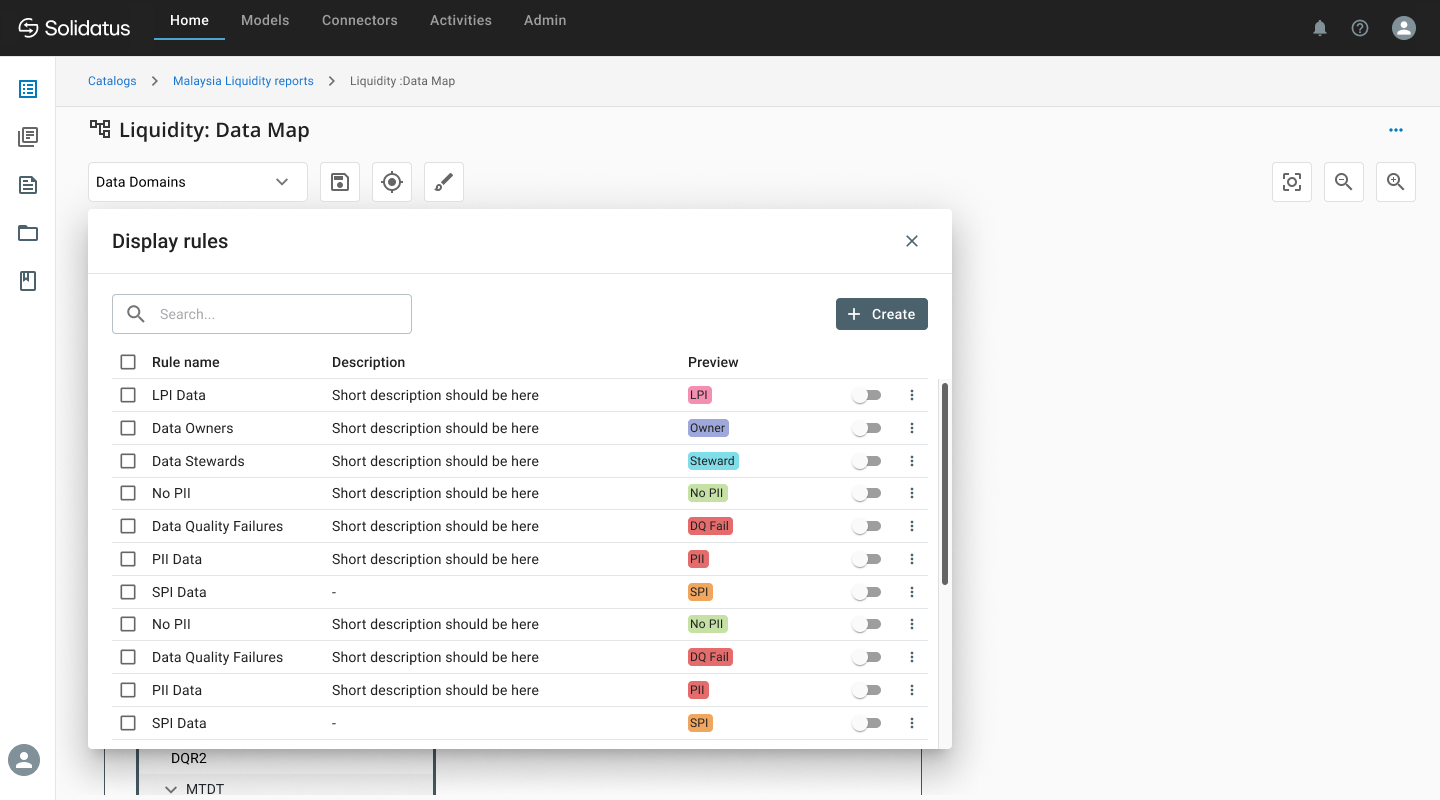
An update on some recent developments in our latest product releases
Read more about data lineage and its business impact, including on AI, BCBS 239 and more
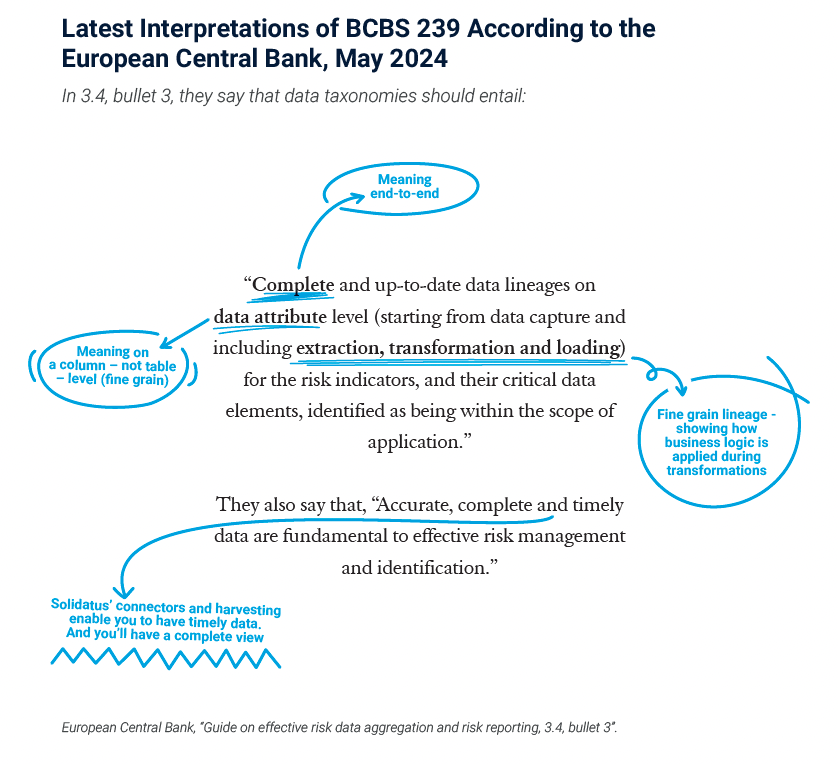
Navigate BCBS 239’s rigorous standards with advanced data lineage
Solidatus data lineage partners with Microsoft Purview to help enterprises trust their data

Read about the new Solidatus interface
Read our key takeaways from Gartner D&A Summit 2024

Video introducing our new interface and core features like Connected Catalog and Data Map
Read about Solidatus and Snowflake Horizon's governance solution
Explore the various aspects of data lineage and its crucial role in your organization.

Basel III is changing – are you prepared? Read 3 easy steps with Solidatus
Read how we helped successfully launched the Houston Women in Data Chapter

Exploring the parallels between urban planning and data planning projects

71% of senior data leaders in financial services polled are close to quitting their jobs

Take a look at what's new in our partnership with Snowflake

VP Product, Tina Chace, reflects on the Gartner conference, covering data governance and AI

We’ve linked the Eurovision Song Contest to the realm of data governance and data lineage

In the latest Gartner® research note, find out what active metadata is

The role of metadata, dynamic visualization and inference across metadata

Automatic connectors are essential for efficiently mapping metadata but not all are created equal. We look at the most important...

We discuss injecting active metadata into your governance and 4 other things we’re looking forward to at the Gartner® Data...