








































Solidatus 2026.3 puts data lineage where AI agents can reach it

MCP support, Bring Your Own LLM, and an assistant that keeps its context
By Danny Waddington, Chief Technology Officer, Solidatus
At the Gartner Data & Analytics Summit in London this May, Director Analyst Anurag Raj told the audience that “data governance will be the single point of failure for organizations’ AI ambitions.” He set out the work ahead in three parts, namely governance of AI, governance by AI, and governance for AI.1
Those three parts describe where we have been building. Solidatus 2026.3 puts something into each of them, and one requirement runs through all three. AI-assisted lineage work happens across days and across people, so a platform that forgets what happened yesterday makes the person do the remembering.
The AI Assistant now keeps its conversations. History persists across browser sessions, organized by recency, and you can search, rename, or delete past chats from the assistant panel. Administrators can switch history off where policy requires it.
Long investigations used to end at the context limit. Chat Rollup now carries your active state and filters into a fresh conversation when a session fills up, along with the traces and key entities you were working on, so a half-finished impact analysis survives into the next chat rather than being rebuilt from memory.
The Prompt Library stores reusable prompts, tagged and scoped either to a single data lineage model or to every session, which turns one steward’s phrasing for a recurring regulatory question into something the whole team can run. Quick Actions propose the next step from the current session, and you can queue a follow-up request while the assistant is still answering.
Bring Your Own LLM (BYOLLM) lets you run the AI Assistant against your own model provider and keys. For a team with data sovereignty requirements, an approved-model list, or a security review that has already cleared one provider, that removes a question which used to stall AI adoption before it started. Misconfigured LLM settings now return a specific error rather than a generic failure.
Underneath, the governance model is unchanged. Every suggestion the assistant makes is staged for a person to approve, and every accepted change becomes an attributed, timestamped revision in the data lineage model’s history. When someone asks which AI-proposed mapping reached production and who approved it, the version history holds the answer. That record is what separates AI governance questions a data catalog cannot answer from ones your lineage can.
Solidatus now exposes a Model Context Protocol (MCP) server. External AI tools and agents can read and write data lineage model content through it, and both basic and extended MCP capabilities are supported.
Most AI assistants deployed inside a bank answer from whatever context they happen to reach, which is how AI failures start in financial services. Connecting one to a governed data lineage model means its answer traces back to something a person modeled and approved, with the evidence attached. Access is enabled per customer, so speak to your Account Manager.
Faster answers raise the speed at which people expect to navigate the enterprise data they are asking about. Several changes in 2026.3 go to that.
Data Domains now include a Domain Spine that stays visible as you move through a domain, keeping Home, the AI Assistant, the Reference Hub, Lineage Models, and saved Data Maps one click away. Lineage models have a proper home inside the domain, with a dedicated page listing everything connected. Entity and sub-entity pages carry a searchable, paginated hierarchy table, so nested structure is navigable without leaving the domain.
Data Maps now save without reloading the page, and display rules persist on saved views. Analytics reports can be edited and deleted straight from the domain home page, and you can export the records behind any metric to CSV from the drill-down panel, which is the difference between reporting a governance number and handing someone the evidence that produced it. Continued modernization work also improves how large models load, navigate, and render.
When you upgrade, take the regulatory question your team currently answers by hand and make it a Prompt Library entry scoped to the model it applies to, so the next person who needs that trace runs it in one step instead of reconstructing it. Point BYOLLM at whichever provider your security team has already cleared, ahead of your next model risk review rather than during it. Then pull the CSV behind one governance metric you report upward, so the number arrives with the records that produced it.
The full 2026.3 release notes cover everything in this release, including the usability work and platform fixes not described here. For on-premises upgrades, check the Ops Release Notes before planning your rollout, and for questions about your environment, BYOLLM, or MCP access, contact your Account Manager or Customer Success Manager.
1Gartner. “Gartner Data & Analytics Summit 2026 London: Day 2 Highlights.” Gartner Newsroom, May 12, 2026.
https://www.gartner.com/en/newsroom/press-releases/2026-05-12-gartner-data-and-analytics-summit-london-2026-day-2-highlights
01.
Solidatus 2026.3 extends the AI Assistant with persistent conversation history, Chat Rollup for long sessions, a Prompt Library, Quick Actions, and queued follow-up requests. It adds Bring Your Own LLM support and a Model Context Protocol server for external AI tools. Data Domains gain a Domain Spine for navigation, a dedicated Lineage Models page, and searchable entity hierarchy tables, while Analytics reports gain CSV export from metric drill-down. Full details are in the 2026.3 release notes.
02.
Bring Your Own LLM (BYOLLM) lets an organization run the Solidatus AI Assistant against its own large language model provider and API keys rather than a Solidatus- managed model. Teams with data sovereignty obligations, an approved-model list, or a completed security review for a specific provider can adopt AI-assisted data lineage work without introducing a new vendor into the assessment. Contact your Account Manager to enable it for your environment.
03.
The Model Context Protocol (MCP) server lets external AI tools and agents connect to Solidatus and work with data lineage model content, supporting both read and write operations across basic and extended MCP capabilities. An AI assistant connected through MCP answers from a governed data lineage model that people have built and approved, rather than from whatever context it can otherwise reach. Access is enabled per customer through your Account Manager.
04.
Every suggestion the AI Assistant makes is staged for a person to review before it commits, and each accepted change becomes an attributed, timestamped revision in the data lineage model’s version history. Because Solidatus stores lineage bi-temporally, you can compare any two points in time and reconstruct what a model looked like on a given date. That record answers which AI-proposed change reached production, who approved it, and when.
05.
Start with a regulatory question your team currently answers by hand, such as tracing a critical data element back to its source, and save it as a Prompt Library entry scoped to the relevant data lineage model so the whole team can run it. Point BYOLLM at a provider your security team has already cleared, ahead of your next model risk review. Then export the records behind one governance metric you report upward, using CSV drill-down in Analytics reports.
Published on: July 6, 2026

What your data lineage has to prove before an examiner asks about a past decision

What runtime capture reaches, and what you have to model yourself.

Why a residency commitment is not evidence of custody.

Why data governance programs fail

Three criteria that make regulatory data lineage reusable

How data lineage brings assessment discipline to financial services data flows

A buyer's guide to choosing the foundation of your AI stack.

Pre-change impact analysis for data estates that feed AI

What BCBS 239 and SR 26-2 now demand at the column level

Bi-temporal data lineage is the foundation of forensic AI investigation

Why an AI use policy cannot enforce itself.

How LSEG turned data lineage into a strategic asset for AI trust

What regulators expect when they ask you to prove data lineage

Why catalog-first tools fall short when regulators ask how your training data moved

When an AI model starts producing unexplainable results, the first instinct is to blame the model. Teams often rush to...

Five data lineage myths that the masterclass got right

What regulators are already asking about your AI, and what it takes to respond
Three questions your AI governance approach must answer

Three institutions receive the same question during Model Risk Management reviews: “Walk us through the complete data lineage for your...

Solidatus’ Tina Chace and fellow experts reveal why 90% of AI model failures trace back to upstream data changes

AI-ready data lineage is a comprehensive, auditable record of how data flows through your organization, designed to support AI governance...

In May 2024, the ECB released its ‘Guide on effective risk data aggregation and risk reporting (RDARR)’...
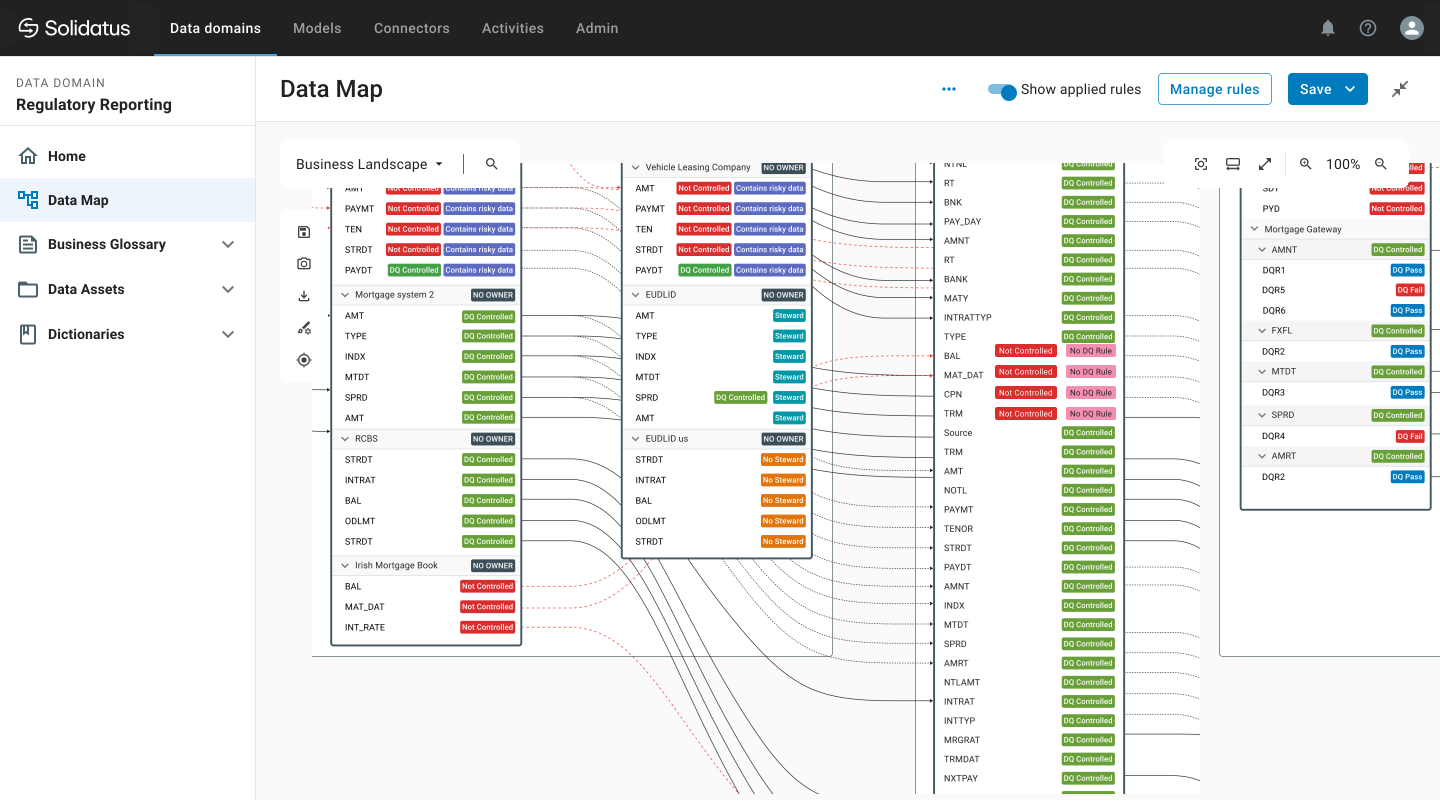
Read why advanced data lineage is crucial for business success
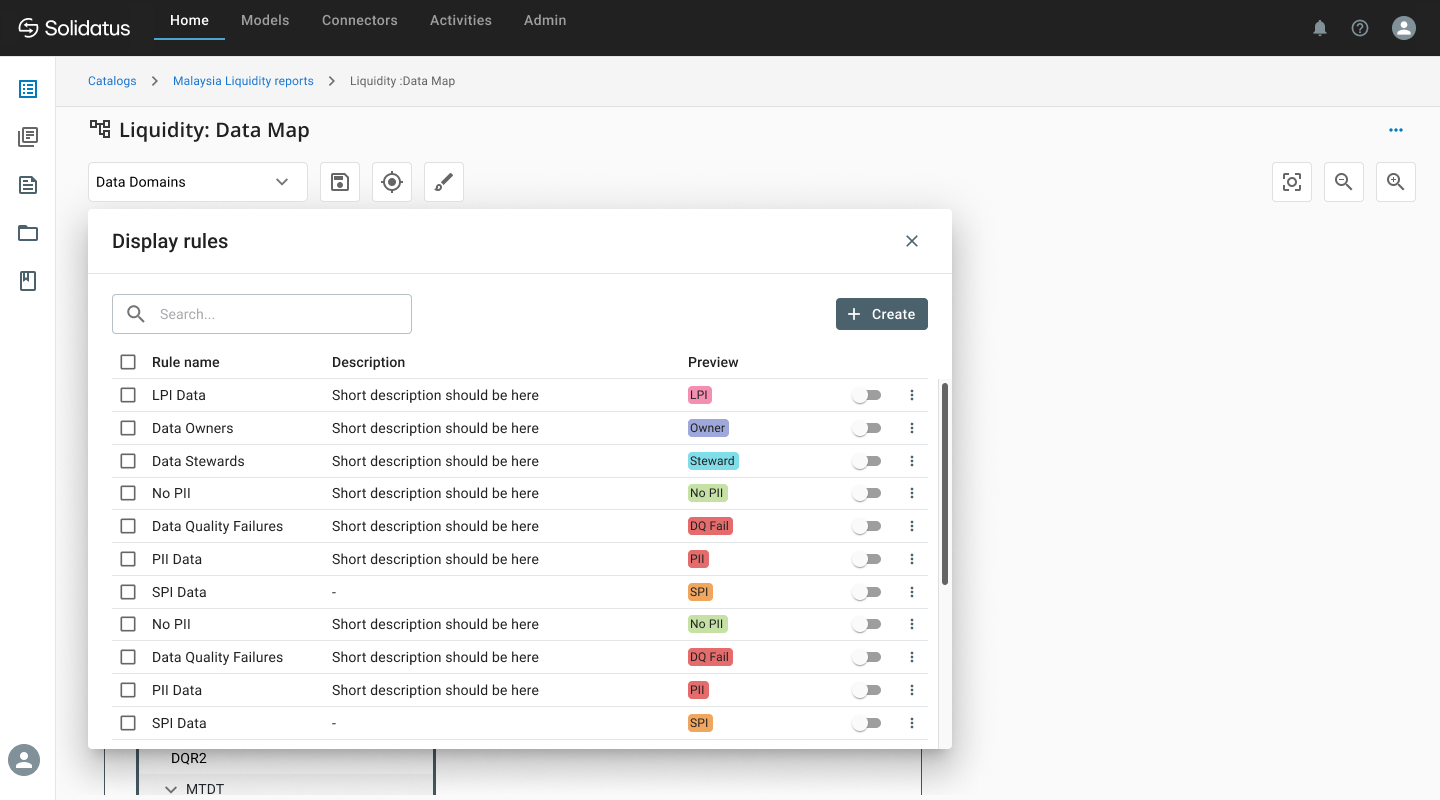
An update on some recent developments in our latest product releases
Read more about data lineage and its business impact, including on AI, BCBS 239 and more
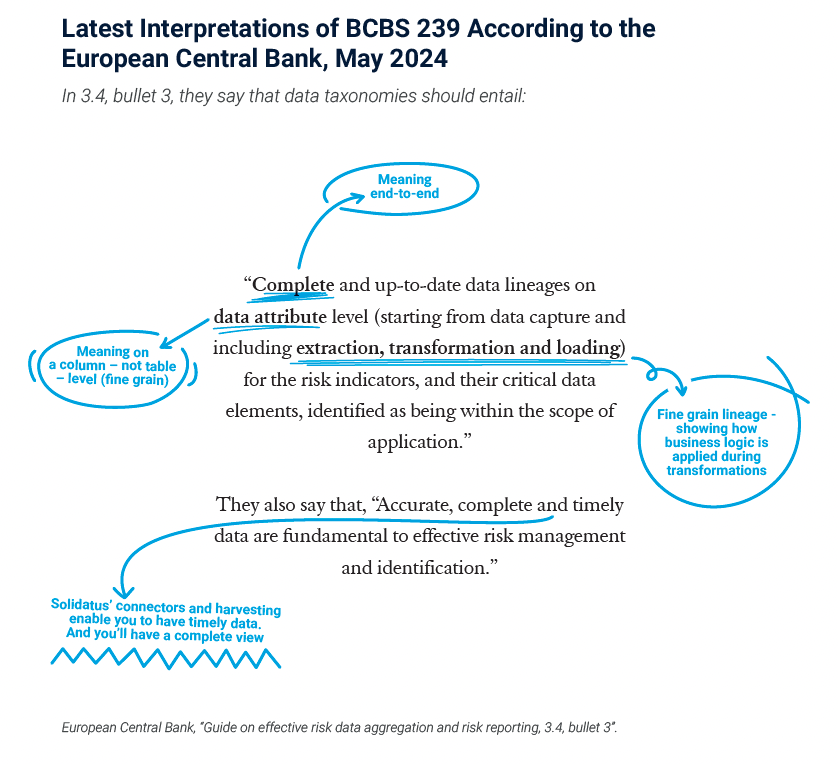
Navigate BCBS 239’s rigorous standards with advanced data lineage
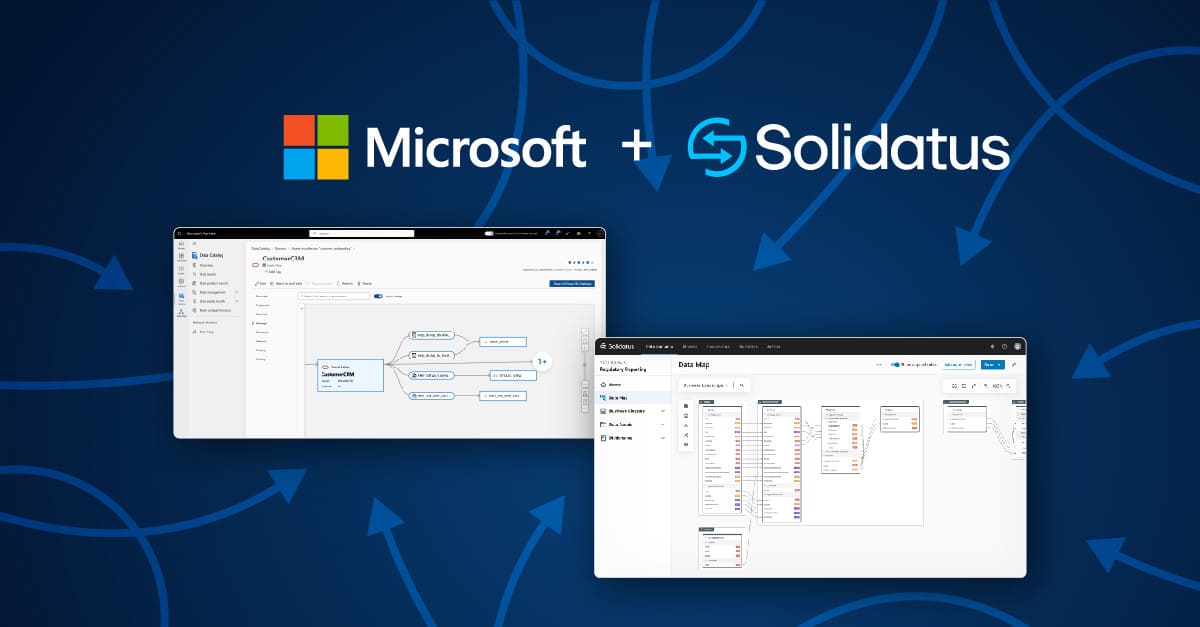
Solidatus data lineage partners with Microsoft Purview to help enterprises trust their data

Read about the new Solidatus interface
Read our key takeaways from Gartner D&A Summit 2024

Video introducing our new interface and core features like Connected Catalog and Data Map
Read about Solidatus and Snowflake Horizon's governance solution
Explore the various aspects of data lineage and its crucial role in your organization.

Basel III is changing – are you prepared? Read 3 easy steps with Solidatus
Read how we helped successfully launched the Houston Women in Data Chapter

Exploring the parallels between urban planning and data planning projects

71% of senior data leaders in financial services polled are close to quitting their jobs

Take a look at what's new in our partnership with Snowflake

VP Product, Tina Chace, reflects on the Gartner conference, covering data governance and AI

We’ve linked the Eurovision Song Contest to the realm of data governance and data lineage

In the latest Gartner® research note, find out what active metadata is

The role of metadata, dynamic visualization and inference across metadata

Automatic connectors are essential for efficiently mapping metadata but not all are created equal. We look at the most important...

We discuss injecting active metadata into your governance and 4 other things we’re looking forward to at the Gartner® Data...