














































Basel IV runs on data that BCBS 239 already governs

Where risk data aggregation and capital calculation rules overlap
UK banks start calculating capital under Basel 3.1 on January 1, 2027, and EU banks are already two years into the same rules.1,2 As your bank prepares, someone will ask the data team a fair question: does the BCBS 239 program already cover this? The program covers part of it, because the two frameworks govern different things and intersect only at the data that feeds the capital calculation. That overlap determines whether you build your data lineage once or twice.
No regulator uses the name Basel IV. The Basel Committee on Banking Supervision called its December 2017 package “Basel III: Finalising post-crisis reforms,” and each jurisdiction adopts it under its own label.3 The EU adopted it through the third Capital Requirements Regulation (CRR3), the UK Prudential Regulation Authority (PRA) adopted it as Basel 3.1, and US agencies re-proposed their version, known as the Basel III endgame, in March 2026.4 The industry shorthand stuck because the package changes capital outcomes enough to feel like a new accord, and our Basel III overview covers the earlier reforms it completes.
In its 2025 supervisory review, the European Central Bank (ECB) found “no improvement in the relevant average sub-score” for risk data aggregation and risk reporting (RDARR) compared with the year before.5 That leaves your bank calculating new capital figures on data your supervisors already question. The ECB’s monitoring strategy also names data quality management and IT and data architecture as its next areas of focus, and Basel IV’s inputs depend on both.
BCBS 239 is the set of 14 principles for risk data aggregation and risk reporting that the Basel Committee published in January 2013.6 The principles cover governance and data architecture, the accuracy and completeness of aggregated risk data, and the way risk reports reach senior management and the board. They set no capital requirement and assign no risk weight. Global systemically important banks (G-SIBs) were expected to comply by 2016, and the principles encourage national supervisors to apply them to domestic systemically important banks (D-SIBs) as well.
Basel IV covers the capital side. It rewrites the standardized approaches for credit and operational risk, updates the market risk rules known as the Fundamental Review of the Trading Book (FRTB), and limits how much a bank’s internal models can reduce its risk-weighted assets. The package does not describe how a bank should govern, trace, or reconcile the data those calculations consume.
| BCBS 239 | Basel IV | |
|---|---|---|
| What it governs | How risk data is aggregated and reported | How much capital a bank holds against its risks |
| Form | 14 principles enforced through supervisory expectations | Calculation rules written into capital regulation |
| Who it applies to | G-SIBs, and D-SIBs where supervisors extend it | Banks in each adopting jurisdiction, as that jurisdiction scopes it |
| What it says about lineage | The ECB guide expects attribute-level lineage | Nothing directly |
| How it is checked | Supervisory review and on-site inspections | Regulatory capital reporting and disclosure |
| Key dates | Principles 2013; ECB guide May 2024; ECB inspections planned through 2028 | EU from 2025; UK from 2027; full effect in both by 2030 |
Because Basel IV and BCBS 239 look unrelated on paper, they often end up with different owners. Basel IV goes to finance and capital management, and BCBS 239 goes to the chief data office or the risk data function. Each team then documents the same source systems for its own purpose, and the bank pays for lineage twice while neither version covers the full path from a source field to the capital ratio.
Both frameworks depend on the data that feeds the capital calculation. Every Basel IV risk weight depends on inputs a bank must source, aggregate, and keep accurate, and the BCBS 239 principles govern that work.
Under the revised standardized approach, for example, the risk weight for most residential real estate exposures depends on the loan-to-value (LTV) ratio.7 The Basel text defines LTV as “the amount of the loan divided by the value of the property.” The loan amount declines as the loan amortizes, and, with limited exceptions, the property value stays at its origination value. That one ratio draws on at least two systems: the loan servicing platform that holds the current balance and the collateral system that holds the original valuation. When the two disagree about which property secures which loan, the risk weight is wrong, and so is the capital figure built on it.
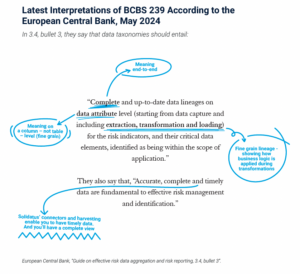
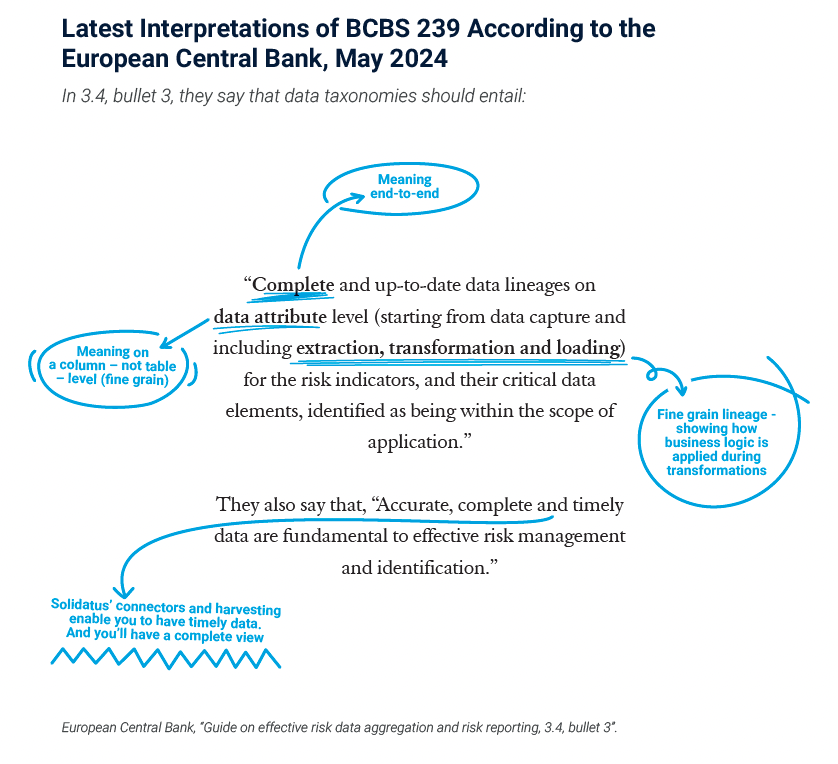
Supervisors have been specific about what proof of those inputs looks like. The ECB’s May 2024 guide calls for “complete and up-to-date data lineages on data attribute level,” which for the mortgage example means lineage for the balance and valuation fields themselves.8 The Basel Committee’s January 2026 newsletter makes the same point from the standard-setter’s side.9
“Data lineage, or the traceability of data from its origin to its final use, is important for confirming data quality.”
— Basel Committee on Banking Supervision, Newsletter No. 36, January 2026
Under Basel IV, the capital ratio is one of those final uses. A bank that can trace an LTV input from the collateral system to the reported ratio therefore has evidence for both frameworks at once. The risk data team can show the ECB the attribute-level lineage it expects, and the capital team can find the source system behind any risk weight that looks wrong.
Internal-model rules create a second overlap between capital rules and data principles. A bank approved to use internal models must also calculate its risk-weighted assets under the standardized approaches, and its risk-weighted assets are the higher of the internal-model figure and 72.5% of the standardized figure.10 The EU phases that percentage in from 50% in 2025 to 72.5% in 2030, and the UK reaches full implementation on January 1, 2030.11,12 The US takes a different route: the March 2026 re-proposal would have the largest US banks calculate “only one set of risk-based capital ratios” under an expanded risk-based approach.13 This comparison therefore applies under the Basel standard and in the EU and UK.
In practice, every in-scope exposure now runs through two calculation engines. The internal model uses the bank’s own estimates of default probability and loss, while the standardized engine applies prescribed risk weights to inputs such as LTV. Both engines must start with the same exposure, counterparty, and collateral record. When they draw on different copies of that data, the bank can’t explain the difference between the two figures, and a supervisor reviewing the comparison can’t separate model risk from a data error. A quarterly finance reconciliation catches a difference between the two totals, and attribute-level lineage shows which input field produced it.
To prove both engines start from one authoritative source, a bank needs lineage that spans both. A lineage tool built into one data platform can show the path through that platform’s pipelines, but it stops where the data leaves that platform for the other engine. Solidatus, a data lineage platform built for regulated enterprises, joins lineage from catalogs, data platforms, and legacy systems into one end-to-end lineage model so that a reviewer can trace a single exposure from its source fields through both calculations to the capital ratio.
Because Basel IV phases in, each year’s capital ratio is calculated under different rules. Between 2025 and 2030, an EU bank compares its internal-model figure with a rising percentage of its standardized figure while its source systems keep changing. FRTB arrives on its own schedule, now January 1, 2027, in the EU.14 A ratio reported in 2026 came from the 2026 percentage and the 2026 state of the data. When a supervisor asks in 2028 why that ratio moved, the bank has to reproduce the lineage as it stood in 2026, before two years of system changes rewrote it.
The ECB plans targeted on-site inspections of RDARR frameworks through 2028 for banks with severe or unresolved findings, which overlaps the middle of the EU phase-in.15 Most catalog and platform lineage records what their scanners last saw, so teams must rebuild an earlier state by hand from change logs. Solidatus stores lineage bi-temporally and keeps a version history of the lineage model, so a team can open the model as it stood on any reporting date and compare it with today’s. A supervisor’s questions about past ratios depend on that point-in-time lineage.
The version history also lets a team look ahead. Before an FRTB go-live, the team can model the data changes in a sandboxed copy of the lineage model and see which capital reports they touch before anything reaches production. One bank in a BCBS 239 program, anonymized in its published story, fed an Oracle data warehouse from 30 sources and cut change impact assessment from months to minutes once its lineage was mapped in Solidatus.
Three steps let you use one lineage program to evidence both BCBS 239 and Basel IV.
So does your BCBS 239 program already cover Basel IV? It covers the inputs, as long as its lineage reaches the capital ratio and records how that lineage looked on each reporting date. For the full set of supervisory expectations, including what an ECB targeted inspection examines, download our white paper, [Thirteen years of BCBS 239: what examiners are asking for]([WHITE PAPER LINK]). Our BCBS 239 page explains how Solidatus supports each of the principles.
[1]European Parliament and Council of the European Union. “Regulation (EU) 2024/1623 Amending Regulation (EU) No 575/2013 (CRR3).” Official Journal of the European Union, June 19, 2024.
https://eur-lex.europa.eu/eli/reg/2024/1623/oj.
[2]Prudential Regulation Authority. “PS1/26: Implementation of Basel 3.1: Final Rules.” Bank of England, January 20, 2026.
https://www.bankofengland.co.uk/prudential-regulation/publication/2026/january/implementation-of-the-basel-3-1-final-rules-policy-statement.
[3]Basel Committee on Banking Supervision. “Basel III: Finalising Post-Crisis Reforms.” Bank for International Settlements, December 7, 2017.
https://wwwinputs.bis.org/bcbs/publ/d424.htm.
[4]Board of Governors of the Federal Reserve System, Federal Deposit Insurance Corporation, and Office of the Comptroller of the Currency. “Agencies Request Comment on Proposals to Modernize the Regulatory Capital Framework and Maintain the Strength of the Banking System.” Federal Reserve, March 19, 2026.
https://www.federalreserve.gov/newsevents/pressreleases/bcreg20260319a.htm.
[5]European Central Bank. “Supervisory Priorities 2026-28.” ECB Banking Supervision, November 2025.
https://www.bankingsupervision.europa.eu/framework/priorities/html/ssm.supervisory_priorities202511.en.html.
[6]Basel Committee on Banking Supervision. “Principles for Effective Risk Data Aggregation and Risk Reporting.” Bank for International Settlements, January 2013.
https://www.bis.org/publ/bcbs239.htm.
[7]Basel Committee on Banking Supervision. “CRE20: Standardised Approach: Individual Exposures.” Basel Framework, Bank for International Settlements, in force January 1, 2023.
https://www.bis.org/committees/bcbs/basel-framework/standard/cre/20/inforce/2023-01-01/published/2020-11-26.
[8]European Central Bank. “Guide on Effective Risk Data Aggregation and Risk Reporting.” ECB Banking Supervision, May 2024.
https://www.bankingsupervision.europa.eu/ecb/pub/pdf/ssm.supervisory_guides240503_riskreporting.en.pdf.
[9]Basel Committee on Banking Supervision. “Implementation of the Principles for Effective Risk Data Aggregation and Risk Reporting (BCBS 239 Principles).” Newsletter No. 36. Bank for International Settlements, January 6, 2026.
https://www.bis.org/publ/bcbs_nl36.htm.
[10]Basel Committee on Banking Supervision. “RBC20: Calculation of Minimum Risk-Based Capital Requirements.” Basel Framework, Bank for International Settlements, in force January 1, 2023.
https://www.bis.org/committees/bcbs/basel-framework/standard/rbc/20/inforce/2023-01-01/published/2020-03-27.
[11]European Parliament and Council of the European Union. “Regulation (EU) 2024/1623 Amending Regulation (EU) No 575/2013 (CRR3).” Official Journal of the European Union, June 19, 2024.
https://eur-lex.europa.eu/eli/reg/2024/1623/oj.
[12]Prudential Regulation Authority. “PS1/26: Implementation of Basel 3.1: Final Rules.” Bank of England, January 20, 2026.
https://www.bankofengland.co.uk/prudential-regulation/publication/2026/january/implementation-of-the-basel-3-1-final-rules-policy-statement.
[13]Board of Governors of the Federal Reserve System, Federal Deposit Insurance Corporation, and Office of the Comptroller of the Currency. “Agencies Request Comment on Proposals to Modernize the Regulatory Capital Framework and Maintain the Strength of the Banking System.” Federal Reserve, March 19, 2026.
https://www.federalreserve.gov/newsevents/pressreleases/bcreg20260319a.htm.
[14]European Commission. “Commission Delegated Regulation (EU) 2025/1496 Postponing the Date of Application of Market Risk Own Funds Requirements.” Official Journal of the European Union, September 19, 2025.
https://eur-lex.europa.eu/eli/reg_del/2025/1496/oj.
[15]European Central Bank. “Supervisory Priorities 2026-28.” ECB Banking Supervision, November 2025.
https://www.bankingsupervision.europa.eu/framework/priorities/html/ssm.supervisory_priorities202511.en.html.
01.
Basel IV is the industry name for the Basel Committee’s December 2017 package “Basel III: Finalising post-crisis reforms.” No regulator uses the term. The package rewrites the standardized approaches for credit and operational risk, revises market risk rules through the Fundamental Review of the Trading Book (FRTB), and limits how far internal models can reduce risk-weighted assets. The EU adopted it as CRR3 from January 1, 2025, the UK adopts it as Basel 3.1 from January 1, 2027, and US agencies re-proposed their version in March 2026.
02.
BCBS 239 is a set of 14 principles, published in 2013, that governs how banks aggregate and report risk data. It sets no capital requirement. Basel IV sets capital calculation rules and says nothing about how banks govern the data behind them. The two frameworks overlap in the data inputs to capital calculations, such as loan balances and property valuations behind a mortgage risk weight, which BCBS 239 expects banks to trace with attribute-level data lineage.
03.
Basel IV doesn’t directly mention data lineage. The requirement comes through BCBS 239 because every Basel IV risk weight depends on risk data. The European Central Bank’s May 2024 guide expects “complete and up-to-date data lineages on data attribute level,” and the Basel Committee’s January 2026 newsletter calls lineage “important for confirming data quality.” A bank that traces its Basel IV inputs at the attribute level from source to capital ratio can use one lineage model to evidence both frameworks.
04.
Under the Basel standard and in the EU and UK, a bank approved to use internal models must also calculate its risk-weighted assets under the standardized approaches, and its risk-weighted assets are the higher of the model figure and 72.5% of the standardized figure. Every in-scope exposure runs through two calculation engines. If the engines draw on different copies of the exposure, counterparty, or collateral data, the bank can’t explain the difference between its two figures. Lineage spanning both engines shows they start from a single authoritative source.
05.
In the EU, CRR3 has applied since January 1, 2025, with the internal-model comparison phasing in from 50% to 72.5% by 2030 and FRTB moved to January 1, 2027. The UK Prudential Regulation Authority starts Basel 3.1 on January 1, 2027, with full implementation on January 1, 2030. US agencies re-proposed their capital rules on March 19, 2026, and the proposal would require the largest banks to calculate a single set of risk-based ratios.
06.
Start with one portfolio, such as residential mortgages, and map its exposure, counterparty, and collateral fields at the attribute level from source through both capital calculations in a single lineage model. Link each input to the BCBS 239 principle it evidences, and keep a dated version of the lineage for each reporting date. Solidatus supports this with lineage joined across platforms and legacy systems and a bi-temporal version history that reproduces the lineage as it stood on any past date.
Published on: November 5, 2026

What your data lineage has to prove before an examiner asks about a past decision

What runtime capture reaches, and what you have to model yourself.

Why a residency commitment is not evidence of custody.

Why data governance programs fail

Three criteria that make regulatory data lineage reusable

How data lineage brings assessment discipline to financial services data flows

A buyer's guide to choosing the foundation of your AI stack.

Pre-change impact analysis for data estates that feed AI

What BCBS 239 and SR 26-2 now demand at the column level

MCP support, Bring Your Own LLM, and an assistant that keeps its context

Bi-temporal data lineage is the foundation of forensic AI investigation

Why an AI use policy cannot enforce itself.

How LSEG turned data lineage into a strategic asset for AI trust

What regulators expect when they ask you to prove data lineage

Why catalog-first tools fall short when regulators ask how your training data moved

When an AI model starts producing unexplainable results, the first instinct is to blame the model. Teams often rush to...

Five data lineage myths that the masterclass got right

What regulators are already asking about your AI, and what it takes to respond
Three questions your AI governance approach must answer

Three institutions receive the same question during Model Risk Management reviews: “Walk us through the complete data lineage for your...

Solidatus’ Tina Chace and fellow experts reveal why 90% of AI model failures trace back to upstream data changes

AI-ready data lineage is a comprehensive, auditable record of how data flows through your organization, designed to support AI governance...

In May 2024, the ECB released its ‘Guide on effective risk data aggregation and risk reporting (RDARR)’...

Read why advanced data lineage is crucial for business success
An update on some recent developments in our latest product releases
Read more about data lineage and its business impact, including on AI, BCBS 239 and more
Navigate BCBS 239’s rigorous standards with advanced data lineage
Solidatus data lineage partners with Microsoft Purview to help enterprises trust their data

Read about the new Solidatus interface

Read our key takeaways from Gartner D&A Summit 2024

Video introducing our new interface and core features like Connected Catalog and Data Map

Read about Solidatus and Snowflake Horizon's governance solution
Explore the various aspects of data lineage and its crucial role in your organization.

Basel III is changing – are you prepared? Read 3 easy steps with Solidatus
Read how we helped successfully launched the Houston Women in Data Chapter

Exploring the parallels between urban planning and data planning projects

71% of senior data leaders in financial services polled are close to quitting their jobs

Take a look at what's new in our partnership with Snowflake

VP Product, Tina Chace, reflects on the Gartner conference, covering data governance and AI

We’ve linked the Eurovision Song Contest to the realm of data governance and data lineage

In the latest Gartner® research note, find out what active metadata is

The role of metadata, dynamic visualization and inference across metadata

Automatic connectors are essential for efficiently mapping metadata but not all are created equal. We look at the most important...

We discuss injecting active metadata into your governance and 4 other things we’re looking forward to at the Gartner® Data...