
























Six questions your AI audit trail has to answer

What bank examiners ask about an agent’s decision after SR 26-2
An examiner picks one alert that your anti-money laundering (AML) triage agent cleared last quarter and asks six questions about it.
The AI platform team offers the trace log (the engineering record of each step the agent took), and the examiner wants something else: what was supposed to happen, and on whose authority.
On October 13, 2026, Reuters reported that the Federal Reserve, the Office of the Comptroller of the Currency (OCC), and the Federal Deposit Insurance Corporation (FDIC) are asking banks what limits they place on autonomous AI systems, how those systems’ actions are monitored and approved, and “whether banks can clearly track and audit AI agent decisions.”1 The questions arrive six months after the same three agencies placed generative and agentic AI outside the scope of SR 26-2, the revised model risk management guidance, and left it to each bank’s own governance practices to set what the controls should look like.2
In KPMG’s third-quarter 2026 AI pulse survey, 80 percent of the US banking leaders polled named data readiness and access (whether the data an agent needs is fit for use and reachable) as the top obstacle to deploying agents, up from 63 percent a quarter earlier. Three-quarters now bar agents from sensitive data without human oversight.3 Each of the six questions has an answer somewhere in your bank, in a different system each time, and none of those systems was built to be joined to the others.
The chat log is the first thing many teams produce, and it records what the agent said rather than what it consumed. An AML triage agent reads transaction tables and the customer master record, and it retrieves passages from a vector store built by chopping policy PDFs into fragments. That chopping step strips the page, the document version, and the approval status from every fragment, so the agent can quote a paragraph from a 200-page sanctions policy with no path back to the edition it came from.
The European Central Bank has already set an expectation for recording what a system read. Its May 2024 guide on risk data aggregation and risk reporting expects data lineage, the record of where each data element came from and what it passed through, at the level of the individual data attribute, for the risk indicators and critical data elements within its scope.4 Applied to an agent, that means a lineage record that starts at each table column and each document fragment and follows every join, filter, and embedding step to the input the agent saw. Neither the chat log nor a data catalog whose lineage ends at the warehouse, before the embedding step, can supply that record.
SR 26-2 expects model governance to rest on clear policies, with named individuals responsible for each activity in the model lifecycle and documentation adequate to support continuity of operations.5 A policy record that meets that expectation has a named owner and a version with an effective date, alongside evidence that the version in use is the one in force. For an agent, the same record has to cover the system prompt that tells it to escalate transactions over $10,000, the tool definition that grants it read access to the monitoring database, and the guardrail that routes any sanctioned-counterparty match to a human.
In many banks, those three artifacts live in a configuration file under Git version control, with an engineer’s username on each change. Git answers “what changed and when” and leaves open who owns the prompt, which clause of the AML policy it implements, and whether the version running on the day of the decision had been approved. The EU AI Act sets a comparable expectation for high-risk AI. It requires that the technical documentation and logs behind a decision be kept and produced for authorities on request. For stand-alone high-risk systems such as credit scoring, the compliance date is now December 2, 2027.6
Your AI platform lead will tell you that observability tooling answers what the agent did, and for engineering purposes it does, because trace logs capture every retrieval, tool call, and output, along with each’s latency. SR 26-2 describes a different artifact: its governance section counts “tracking of recommendations, responses, and exceptions” among the things adequate documentation supports.7 For an agent, that tracking covers what it was supposed to do, whether it did that, and who owns any deviation.
A trace shows that the agent cleared the alert at 14:07 after reading four records, and nothing in it says whether the prompt version behind the decision had been approved, whether the data source was authorized for that use, or whether anyone reviewed the outcome. Those facts sit in the policy system, the data catalog, and a workflow tool, and the trace shares no identifier with any of them. Today an analyst joins the action to the approvals behind it by hand, for each decision the examiner selects.
When a schema change in the transaction feed renames a field, the triage agent raises no alarm and keeps running. It reads whatever field it can find and produces confident clearances at a thousand alerts an hour, and nobody files an incident because nothing broke. By the time the quarterly review runs, the agent has made weeks of decisions based on misunderstood data, and every downstream report and process has inherited the error.
SR 26-2 counts assessing model risk in aggregate, as well as model by model, as sound practice, where aggregate risk reflects “interactions and dependencies among models” and “reliance on common assumptions, data, or methodologies.”8 At the data level, a single market data feed can flow into forty or more models across credit, market risk, and treasury, so model risk starts in the data supply chain. The model risk team maps those dependencies from inventories on a periodic review cycle, and an agent starts consuming and producing data between two reviews, before any inventory records it. The examiner asks which models, agents, and reports depended on the changed field and expects the answer from the lineage record rather than from a survey of the teams.
Ownership answers are spread across four systems. Data ownership lives in the catalog and model ownership in the model risk inventory. In contrast, policy ownership is held in the policy management platform and prompt ownership, where it exists at all, is the username on a Git commit. Principle 2 of BCBS 239, the Basel Committee’s standard for risk data aggregation and reporting, expects named owners for risk data in both the business and IT functions, and SR 26-2 asks the same of each activity in the model lifecycle.9,10 Neither describes a bank pulling four owner records together for one decision.
For one cleared alert, the examiner wants the owner of each data source, prompt, and tool definition that was in force at the time, and the effective date of each approval. Hold ownership in the lineage record, next to the artifact each owner is accountable for, and one query returns all of them.
To show the decision as it stood on the day it was made, a bank has to produce the data the agent read, the prompt and policy versions, its action, the dependencies, and the approvals, all as of one date. The answers to the first five questions must have been joined when they were recorded, and a lineage record that holds only the current state cannot supply them, because a correction made after the decision overwrites the version the agent read. An earlier article covers how a lineage record keeps both versions, and how to test whether yours does.
The London Stock Exchange Group (LSEG) began mapping its datasets field by field in 2023, with the EU’s Digital Operational Resilience Act as the trigger point, and has since evidenced reductions in key risk indicators to the group’s risk committee and board, as it told The Banker in 2025.11 Terrence Hedin, LSEG’s Director of Platform Data and Metadata, described the role of lineage on stage at the Gartner Data & Analytics Summit in March 2026.
“Having data lineage is absolutely a foundation for us to really be able to not only run the program, but to establish what we are claiming is trusted data.”
— Terrence Hedin, Director of Platform Data and Metadata, LSEG
Put your own bank through the same examination this quarter, in three steps.
For the architecture behind each answer, the white paper The six audit questions agentic AI will force every regulated bank to answer sets out what the lineage record must include, from the data the agent read to the decision as it stood on any past date.
[1]Reuters. “Banking watchdogs ramp up AI scrutiny as stability fears mount, sources say.” October 13, 2026.
https://www.bnnbloomberg.ca/business/economics/2026/10/13/banking-watchdogs-ramp-up-ai-scrutiny-as-stability-fears-mount-sources-say-reuters-exclusive
[2]Board of Governors of the Federal Reserve System, Federal Deposit Insurance Corporation, and Office of the Comptroller of the Currency. “Supervisory Guidance on Model Risk Management.” SR Letter 26-2 Attachment, April 17, 2026.
https://www.federalreserve.gov/supervisionreg/srletters/SR2602a1.pdf
[3]KPMG. “KPMG Quarterly AI Pulse Survey: Banking, Q3 2026.” October 2026.
https://kpmg.com/kpmg-us/content/dam/kpmg/pdf/2026/banking-aipulsesurvey-q3.pdf
[4]European Central Bank. “Guide on effective risk data aggregation and risk reporting.” May 2024.
https://www.bankingsupervision.europa.eu/ecb/pub/pdf/ssm.supervisory_guides240503_riskreporting.en.pdf
[5]Board of Governors of the Federal Reserve System, Federal Deposit Insurance Corporation, and Office of the Comptroller of the Currency. “Supervisory Guidance on Model Risk Management.” SR Letter 26-2 Attachment, April 17, 2026.
https://www.federalreserve.gov/supervisionreg/srletters/SR2602a1.pdf
[6]European Union. “Regulation (EU) 2026/1744 amending Regulation (EU) 2024/1689 (Digital Omnibus on AI).” Official Journal of the European Union, July 24, 2026.
https://eur-lex.europa.eu/eli/reg/2026/1744/oj
[7]Board of Governors of the Federal Reserve System, Federal Deposit Insurance Corporation, and Office of the Comptroller of the Currency. “Supervisory Guidance on Model Risk Management.” SR Letter 26-2 Attachment, April 17, 2026.
https://www.federalreserve.gov/supervisionreg/srletters/SR2602a1.pdf
[8]Board of Governors of the Federal Reserve System, Federal Deposit Insurance Corporation, and Office of the Comptroller of the Currency. “Supervisory Guidance on Model Risk Management.” SR Letter 26-2 Attachment, April 17, 2026.
https://www.federalreserve.gov/supervisionreg/srletters/SR2602a1.pdf
[9]Board of Governors of the Federal Reserve System, Federal Deposit Insurance Corporation, and Office of the Comptroller of the Currency. “Supervisory Guidance on Model Risk Management.” SR Letter 26-2 Attachment, April 17, 2026.
https://www.federalreserve.gov/supervisionreg/srletters/SR2602a1.pdf
[10]Basel Committee on Banking Supervision. “Principles for effective risk data aggregation and risk reporting.” January 2013.
https://www.bis.org/publications/201301-guidelines-principles-effective-risk-data-aggregation-and-risk-reporting.pdf
[11]Shibli, Aliya. “LSEG’s journey from regulation to revenue through data.” The Banker, September 25, 2025.
https://www.thebanker.com/content/18fd41d8-f187-4b3e-81fa-534797e24f8f
01.
An AI audit trail is the evidence a bank can produce for one decision an AI agent made: the data the agent read, the prompt and policy versions in force, the action it took, the other models and reports that depended on the same data, and who approved each of those, all as of the decision date. A trace log covers the action alone. A bank examiner also asks what the agent was supposed to do and on whose authority, and the audit trail has to answer that.
02.
An examiner asks what data the agent read, which prompt and which policy were in force, what the agent did and whether it was allowed to, what else depended on the data it used, who approved each of those artifacts, and whether the bank can show the decision as it stood on the day it was made. The six questions follow the structure of SR 26-2 and BCBS 239 for traditional models, applied to an agent that changes its inputs between reviews.
03.
No. SR 26-2, the revised US model risk management guidance issued by the Federal Reserve, the OCC, and the FDIC on April 17, 2026, places generative and agentic AI outside its scope and states that a bank’s own risk management and governance practices should determine the controls for them. In October 2026, Reuters reported that the same agencies are asking banks whether they can track and audit AI agent decisions, so the six questions apply in practice even though the guidance does not cover agents.
04.
Agent observability captures every retrieval, tool call, and output with its latency, for engineering purposes, and it shares no identifier with the systems that record approvals and ownership. An AI audit trail joins each action to those approvals and owners: whether the prompt version was approved and the data source authorized, who owns the policy the agent enforced, and what else depended on the same data.
05.
Pick one agent decision and ask for all six answers as of the decision date. Count how many systems the team has to open to produce them. Then add prompts and tool definitions to the data lineage record with the same fields as a policy (owner, version with effective date, and the clause each one enforces), and trace one input the agent used upstream to the first system where the lineage stops. Extend the lineage there, by hand if no connector can read that system.
Published on: November 24, 2026

Where Databricks Unity Catalog lineage stops, and the two questions it leaves open

Where risk data aggregation and capital calculation rules overlap

What your data lineage has to prove before an examiner asks about a past decision

What runtime capture reaches, and what you have to model yourself.

Why a residency commitment is not evidence of custody.

Why data governance programs fail

Three criteria that make regulatory data lineage reusable

How data lineage brings assessment discipline to financial services data flows

A buyer's guide to choosing the foundation of your AI stack.

Pre-change impact analysis for data estates that feed AI

What BCBS 239 and SR 26-2 now demand at the column level

MCP support, Bring Your Own LLM, and an assistant that keeps its context

Bi-temporal data lineage is the foundation of forensic AI investigation

Why an AI use policy cannot enforce itself.

How LSEG turned data lineage into a strategic asset for AI trust

What regulators expect when they ask you to prove data lineage

Why catalog-first tools fall short when regulators ask how your training data moved

When an AI model starts producing unexplainable results, the first instinct is to blame the model. Teams often rush to...

Five data lineage myths that the masterclass got right

What regulators are already asking about your AI, and what it takes to respond
Three questions your AI governance approach must answer

Three institutions receive the same question during Model Risk Management reviews: “Walk us through the complete data lineage for your...

Solidatus’ Tina Chace and fellow experts reveal why 90% of AI model failures trace back to upstream data changes

AI-ready data lineage is a comprehensive, auditable record of how data flows through your organization, designed to support AI governance...

In May 2024, the ECB released its ‘Guide on effective risk data aggregation and risk reporting (RDARR)’...
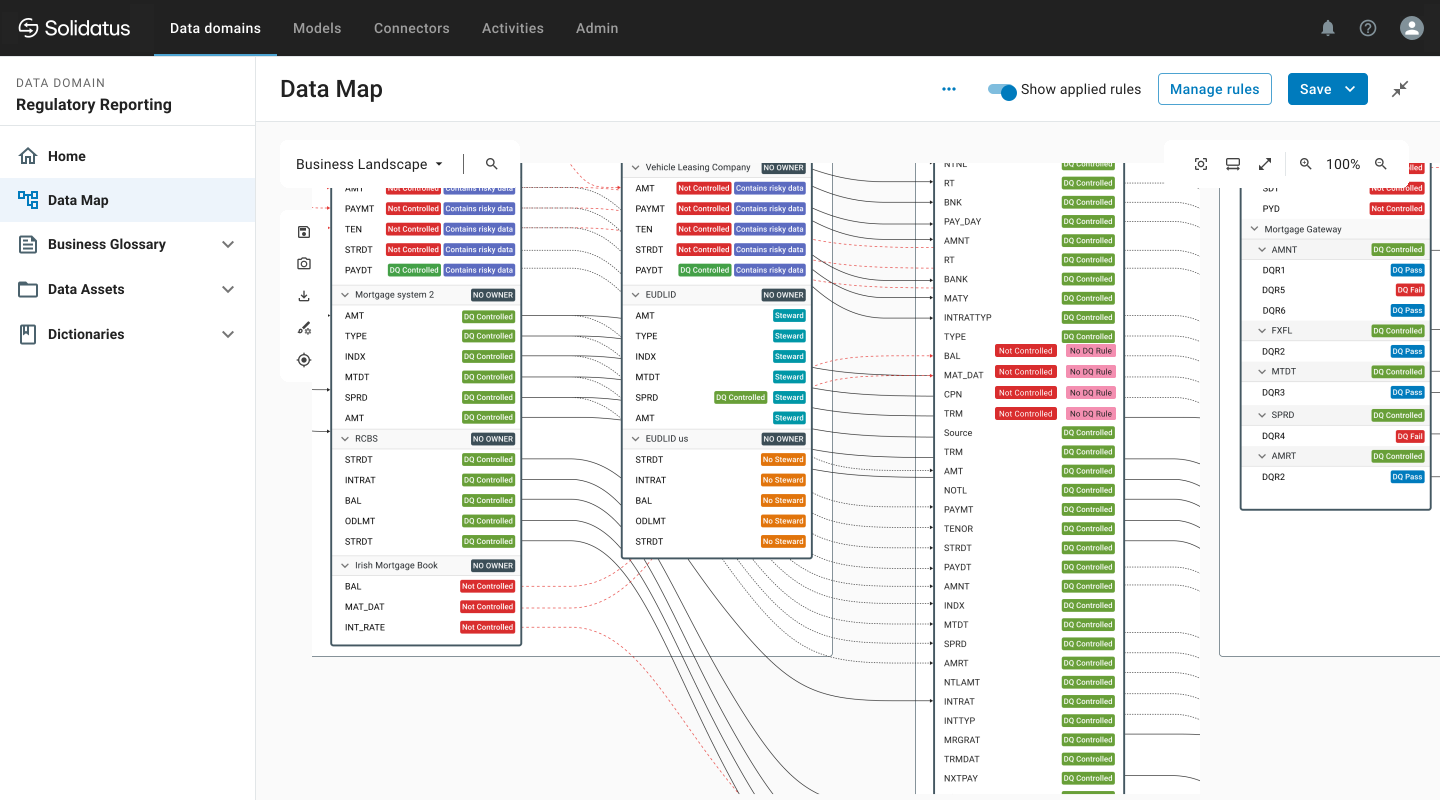
Read why advanced data lineage is crucial for business success
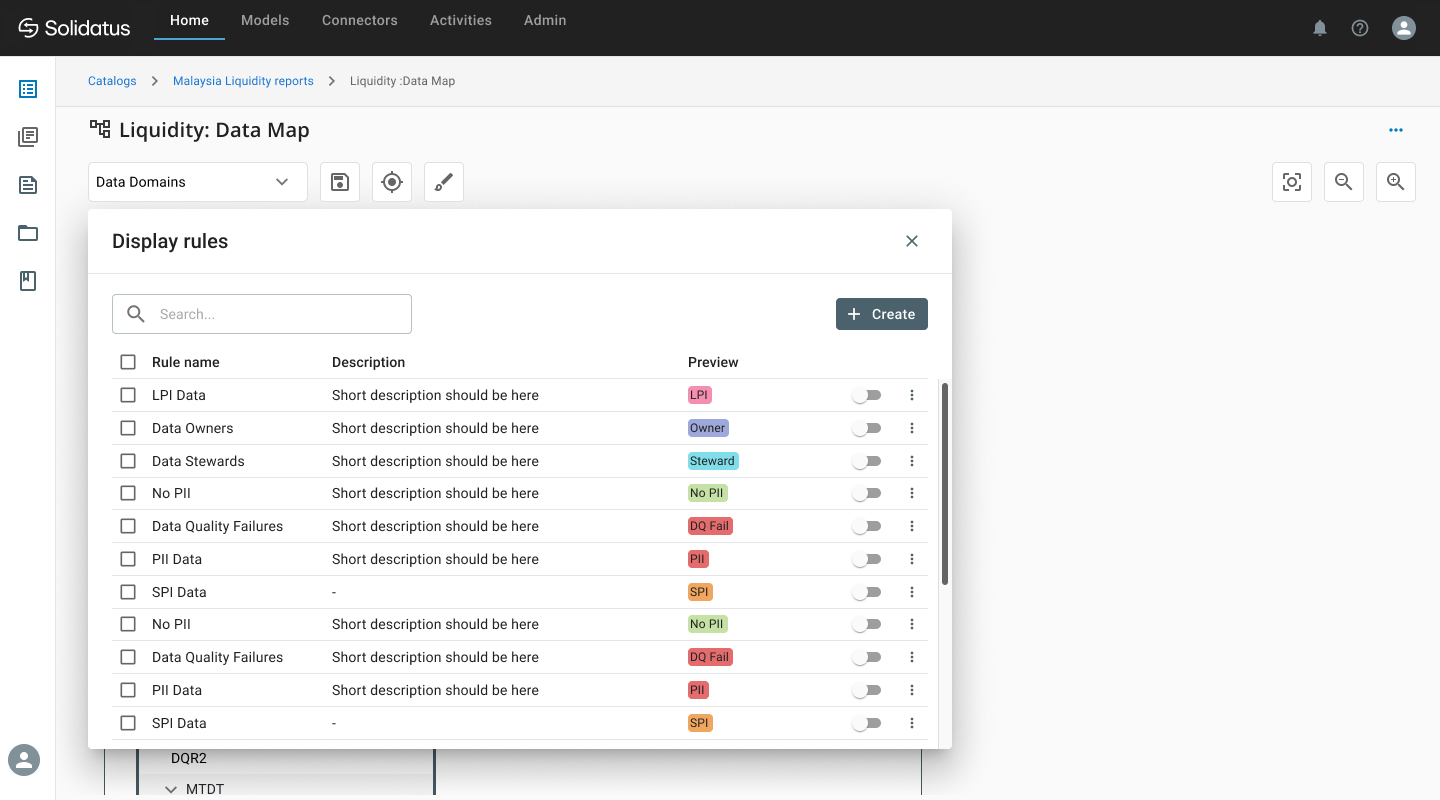
An update on some recent developments in our latest product releases
Read more about data lineage and its business impact, including on AI, BCBS 239 and more
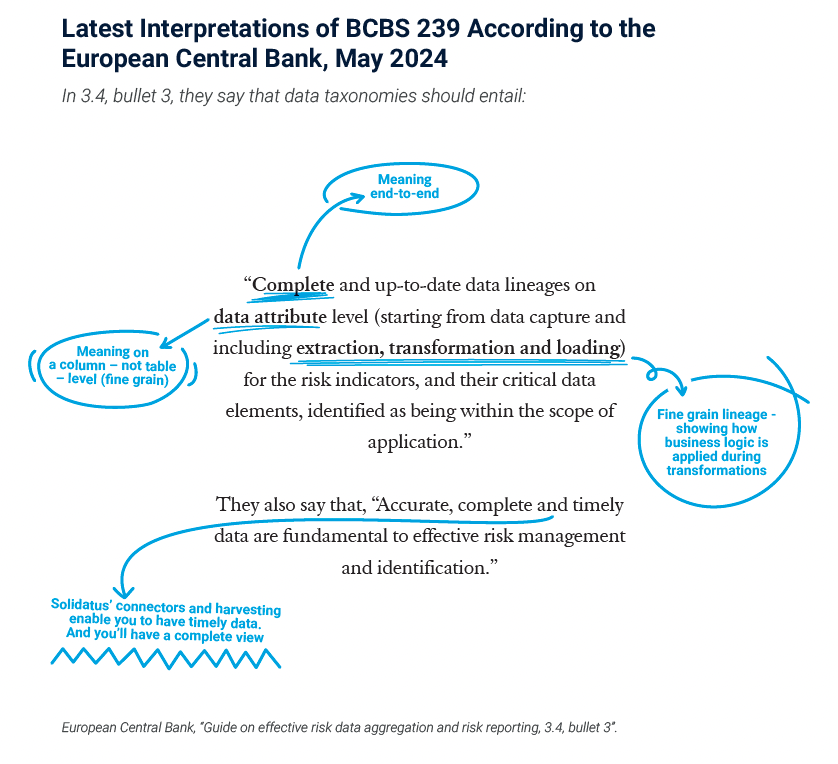
Navigate BCBS 239’s rigorous standards with advanced data lineage
Solidatus data lineage partners with Microsoft Purview to help enterprises trust their data

Read about the new Solidatus interface

Read our key takeaways from Gartner D&A Summit 2024

Video introducing our new interface and core features like Connected Catalog and Data Map
Read about Solidatus and Snowflake Horizon's governance solution
Explore the various aspects of data lineage and its crucial role in your organization.

Basel III is changing – are you prepared? Read 3 easy steps with Solidatus
Read how we helped successfully launched the Houston Women in Data Chapter

Exploring the parallels between urban planning and data planning projects

71% of senior data leaders in financial services polled are close to quitting their jobs

Take a look at what's new in our partnership with Snowflake

VP Product, Tina Chace, reflects on the Gartner conference, covering data governance and AI

We’ve linked the Eurovision Song Contest to the realm of data governance and data lineage

In the latest Gartner® research note, find out what active metadata is

The role of metadata, dynamic visualization and inference across metadata

Automatic connectors are essential for efficiently mapping metadata but not all are created equal. We look at the most important...

We discuss injecting active metadata into your governance and 4 other things we’re looking forward to at the Gartner® Data...