












































Your BCBS 239 evidence expires the day you file it

Three criteria that make regulatory data lineage reusable
Banks have been working on BCBS 239 for thirteen years, and supervisors say they are no better at it than they were a year ago. The Basel Committee published the principles for risk data aggregation and risk reporting (RDARR) in January 2013, with global systemically important banks expected to comply by 2016.1 Banks have built programs against them and reported progress to their boards every year since. In November 2025, the European Central Bank recorded what all of that produced in its annual Supervisory Review and Evaluation Process (SREP).2
“The SREP 2025 outcomes point to persistent deficiencies in banks’ RDARR frameworks, with no improvement in the relevant average sub-score as compared with last year.” — European Central Bank, Supervisory priorities 2026-28
A flat sub-score looks like an underinvestment problem, fixable with more budget and another remediation program. Right? Wrong. Most large banks have already tried that, more than once, and the 2025 SREP result is what came of it.
The institutions that turned regulatory work into an asset the business uses daily did not outspend the ones still rebuilding the same evidence for every new request from regulators. The smart banks made an early decision about how the work would be structured, and that settled whether anything they built survived the supervisory examination that prompted it.
Most banks never decide how their compliance evidence should be structured. The shape of the program decides for them, because a remediation program ends when the examiner closes the finding that started it. An examiner picks a regulatory return, such as a credit risk or liquidity report, and asks where each figure came from. The program traces that reporting chain as it stood on the filing date. Mapping documents, spreadsheets, and screenshots satisfy the finding, and the team moves on. Every step is rational, and together they produce an evidence pack that answers one question once. So what happens when the next question is not the same one?
It rarely is. A different framework names different reports, a supervisor asks how a figure looked at a quarter-end two years back, or a business line reorganizes and the systems underneath it change. Evidence assembled for the original scope does not stretch that far, so a new program starts and rebuilds most of what the last one produced. RDARR remediation becomes a recurring cost.
The Basel Committee explained why this happens in a January 2026 newsletter summarizing what supervisors and banks reported during outreach sessions. It states plainly that it introduces no new expectations, so it describes what supervisors see rather than adding an obligation.3
“Legacy systems, distributed data estates and the dynamic nature of data lineage complicate banks’ efforts to confirm end-to-end data traceability.”— Basel Committee on Banking Supervision, Newsletter No. 36, January 2026
Legacy systems sit beyond the reach of any scanner. Enterprise data spreads across environments never designed to be read together, and lineage shifts underneath the documentation as fast as it is written. A platform limited to automated scanning stops at the first obstacle, so what the bank files is accurate for the systems it could reach and silent about the rest.
Building for reuse changes what the program leaves behind. Reusable data lineage is a model built so evidence assembled for one regulatory question can answer later ones without being rebuilt. A bank cannot add that afterward. It has to be there while the model is built, and one supervisory question is enough to test for it. A risk examiner asks which reports and models consume a particular counterparty rating field, and what that chain looked like on the day the figure was filed. Could your lineage answer that this week? Answering takes three things.
Each is available on its own. Scanners produce technical detail with no business meaning attached, and catalogs hold business definitions without a trace back to source. Keeping all three in one model is what makes the second request cheaper than the first, and it is what most banks discover they skipped.
A bank could once miss one of the three criteria at little cost, because supervisors rarely asked about the same data environment twice. The ECB approved a system-wide strategy in December 2024 that monitors every supervised bank against the risk data expectations and tracks remediation plans. It begins with management accountability and widens into data quality management and IT architecture.4 Banks under it face supervisors already holding the last round’s findings, with targeted inspections where those were severe. It extends the intensifying supervisory approach the ECB signalled earlier.
When the evidence was assembled for a single examination, answering the follow-up means reopening that program and repeating much of the mapping, usually with a new team. A model built to be queried turns the same follow-up into a query against a model that already exists, and the cost difference between those two paths grows with every round of supervisory attention.
HSBC’s wholesale credit and lending work shows what a model built to be queried produces at scale. The team built it to demonstrate traceability from source to consumption across the lending book, plainly regulatory work. Solidatus’s account describes the starting point as a static, single use case and the outcome as a core pillar of the group’s data strategy, with the same model now supporting environmental, social, and governance reporting, liquidity calculations, and risk-weighted asset optimization.5 The regulatory requirement bought an asset the bank now uses daily, and the scale of that model is covered in our earlier piece on why banks cannot meet modern regulations without data lineage.
“With Solidatus, I can visualize the data model for each business outcome, manage the requirements of key stakeholders and provide greater clarity over the intricacies involved in addressing their requests.”— Sid Mubashar, Former Head of Wholesale Credit & Lending Data and Monitoring, HSBC
Mubashar’s phrase, each business outcome, carries the whole argument. A single model serves many of them, queried by people who had no part in building it, which is the practical test of whether regulatory work produced something durable.
Three moves separate a lineage model that answers once from one that keeps answering. Each assumes lineage held as a versioned model rather than a folder of documents, which is what most remediation programs never produce.
Start with one domain already under supervisory attention rather than the whole data ecosystem. Prove the model answers a question you have been asked, then extend it.
Thirteen years of programs, and a sub-score that will not move, describe an industry paying repeatedly for the same work. Each program assembles evidence for the question in front of it, closes, and leaves the next team to start over, so effort keeps rising while the score holds flat. Boards now answer for that cost directly, since the ECB strategy starts with management accountability before it reaches data quality or architecture. The banks that escaped the cycle were not working with simpler data ecosystems. They built the first model so it could answer the second question, and the work stopped recurring as a cost.
Supervisors have said what they are looking for, and the Basel Committee has named traceability from origin to final use as what confirms data quality. The next examination is already scheduled. Will answering it mean running a query, or staffing another program? That was settled when the last model was built.
Solidatus is a data lineage platform built for regulated enterprises, used by organizations including HSBC, Royal London Asset Management, and Bank of New York to model lineage at the individual data field, with version history that makes a past filing reproducible years later. To find out whether your own lineage could answer a second examination without rebuilding, request the banking use case overview.
[1]Basel Committee on Banking Supervision. “Principles for effective risk data aggregation and risk reporting.” Bank for International Settlements, January 2013. https://www.bis.org/publ/bcbs239.htm. Compliance expectation referenced in Basel Committee on Banking Supervision, “Progress in adopting the Principles for effective risk data aggregation and risk reporting,” November 28, 2023. https://www.bis.org/bcbs/publ/d559.htm.
[2]European Central Bank. “Supervisory priorities 2026-28.” ECB Banking Supervision, November 2025.
https://www.bankingsupervision.europa.eu/framework/priorities/html/ssm.supervisory_priorities202511.en.html.
[3]Basel Committee on Banking Supervision. “Implementation of the Principles for effective risk data aggregation and risk reporting (BCBS 239 Principles).” Newsletter No. 36. Bank for International Settlements, January 6, 2026. https://www.bis.org/publ/bcbs_nl36.htm. The newsletter states that it “is for informational purposes only and does not constitute new supervisory guidance or expectations.”
[4]European Central Bank. “Supervisory priorities 2026-28.” ECB Banking Supervision, November 2025.
https://www.bankingsupervision.europa.eu/framework/priorities/html/ssm.supervisory_priorities202511.en.html.
[5]Solidatus. “Solidatus Models HSBC’s Global Lending Book.” Case study, 2024.
https://www.solidatus.com/resource/case-studies/solidatus-models-hsbcs-global-lending-book/.
01.
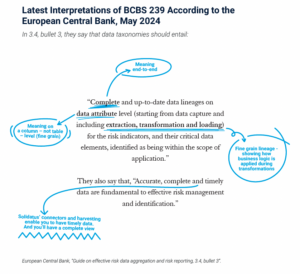
The Basel Committee’s principles for risk data aggregation and risk reporting, published in January 2013, require banks to demonstrate that risk figures can be traced from the systems that captured them to the reports that use them. Global systemically important banks were expected to comply by 2016. The principles leave the technology open. The European Central Bank’s supervisory expectations have since pushed the standard of proof down to the level of individual data attributes, a level spreadsheets and dataset-level catalogs were never designed to reach.
02.
The European Central Bank reported in November 2025 that SREP 2025 outcomes show persistent deficiencies in bank risk data frameworks, with no improvement in the relevant average sub-score year over year. The shortfall is structural rather than financial. Most remediation programs assemble evidence scoped to the single examination that prompted them, so when a new regulation, a new reporting period, or a reorganization arrives, the next program rebuilds much of the same work from the beginning.
03.
Dataset-level lineage records which systems feed which other systems, so it can confirm that a risk platform draws on a customer database. Column-level lineage follows an individual data field through each transformation between origin and report. Supervisors ask about figures, and a figure lives in a column, so only a data lineage model kept at field level can answer the question an examiner asks. Column-level detail is what turns a system diagram into usable regulatory evidence.
04.
Yes, when the model is built for it. HSBC’s wholesale credit and lending model began as regulatory work demonstrating traceability from source to consumption, and Solidatus’s account of the engagement describes it moving from a static, single use case to a core pillar of the group’s data strategy, now supporting environmental, social, and governance reporting, liquidity calculations, and risk-weighted asset optimization. Reuse depends on three criteria being met at build time: field-level granularity, business meaning bound to the technical path, and stored version history.
05.
Newsletter No. 36, published on January 6, 2026, states that data lineage, meaning the traceability of data from its origin to its final use, is important for confirming data quality. It also identifies legacy systems, distributed data estates, and the changing nature of lineage as obstacles to confirming end-to-end traceability. The newsletter states explicitly that it is for informational purposes only and does not constitute new supervisory guidance or expectations, so it reports what supervisors and banks are seeing rather than adding a requirement.
06.
Start with one domain already under supervisory attention rather than the whole data ecosystem, and prove the model can answer a question the bank has already been asked. Three moves make the work reusable: compare the current lineage against the version filed at the last examination to find drift, branch a proposed remediation and check downstream consumers before committing to it, and tag physical fields with the business vocabulary supervisors use so the next framework maps onto structures that already exist.
Published on: September 3, 2026

What your data lineage has to prove before an examiner asks about a past decision

What runtime capture reaches, and what you have to model yourself.

Why a residency commitment is not evidence of custody.

Why data governance programs fail

How data lineage brings assessment discipline to financial services data flows

A buyer's guide to choosing the foundation of your AI stack.

Pre-change impact analysis for data estates that feed AI

What BCBS 239 and SR 26-2 now demand at the column level

MCP support, Bring Your Own LLM, and an assistant that keeps its context

Bi-temporal data lineage is the foundation of forensic AI investigation

Why an AI use policy cannot enforce itself.

How LSEG turned data lineage into a strategic asset for AI trust

What regulators expect when they ask you to prove data lineage

Why catalog-first tools fall short when regulators ask how your training data moved

When an AI model starts producing unexplainable results, the first instinct is to blame the model. Teams often rush to...

Five data lineage myths that the masterclass got right

What regulators are already asking about your AI, and what it takes to respond
Three questions your AI governance approach must answer

Three institutions receive the same question during Model Risk Management reviews: “Walk us through the complete data lineage for your...

Solidatus’ Tina Chace and fellow experts reveal why 90% of AI model failures trace back to upstream data changes

AI-ready data lineage is a comprehensive, auditable record of how data flows through your organization, designed to support AI governance...

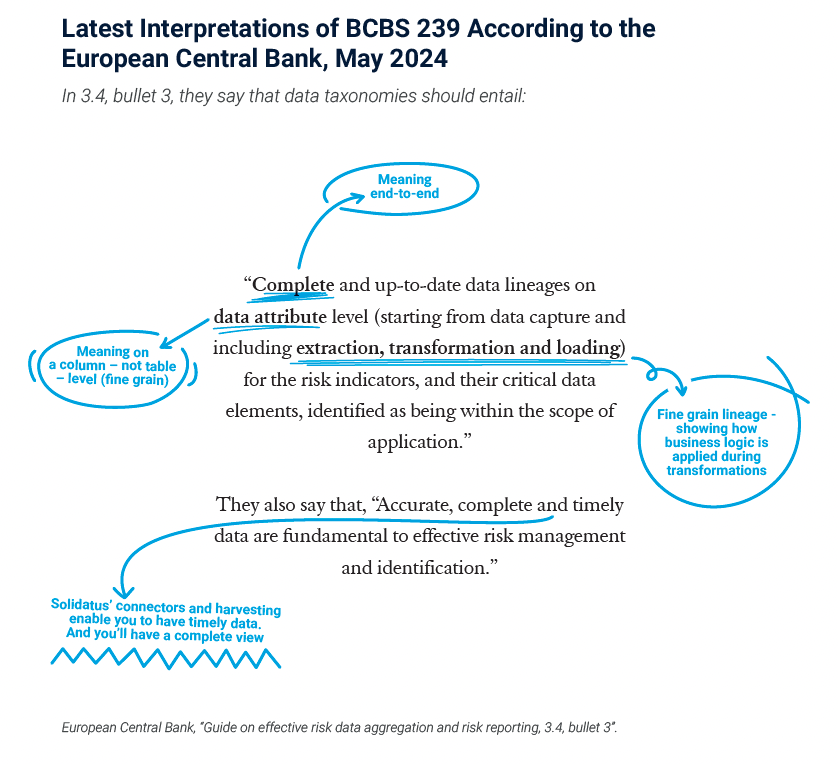
In May 2024, the ECB released its ‘Guide on effective risk data aggregation and risk reporting (RDARR)’...
Read why advanced data lineage is crucial for business success
An update on some recent developments in our latest product releases
Read more about data lineage and its business impact, including on AI, BCBS 239 and more
Navigate BCBS 239’s rigorous standards with advanced data lineage
Solidatus data lineage partners with Microsoft Purview to help enterprises trust their data

Read about the new Solidatus interface

Read our key takeaways from Gartner D&A Summit 2024

Video introducing our new interface and core features like Connected Catalog and Data Map
Read about Solidatus and Snowflake Horizon's governance solution
Explore the various aspects of data lineage and its crucial role in your organization.

Basel III is changing – are you prepared? Read 3 easy steps with Solidatus
Read how we helped successfully launched the Houston Women in Data Chapter

Exploring the parallels between urban planning and data planning projects

71% of senior data leaders in financial services polled are close to quitting their jobs

Take a look at what's new in our partnership with Snowflake

VP Product, Tina Chace, reflects on the Gartner conference, covering data governance and AI

We’ve linked the Eurovision Song Contest to the realm of data governance and data lineage

In the latest Gartner® research note, find out what active metadata is

The role of metadata, dynamic visualization and inference across metadata

Automatic connectors are essential for efficiently mapping metadata but not all are created equal. We look at the most important...

We discuss injecting active metadata into your governance and 4 other things we’re looking forward to at the Gartner® Data...