










































Your lineage coverage metric measures the wrong thing

Why data governance programs fail
Every data governance program reports lineage progress the same way: systems connected, fields mapped, critical data elements covered, and a completion percentage. For the most part, those figures are usually accurate, and they answer a question nobody outside the program is asking. A lineage map covering 40 percent of your enterprise data, or 90 percent, tells you what the team was focused on. Unfortunately, the coverage metric says nothing about whether the organization or an auditor can trace a figure back through your data landscape to its origin.
So, how do you know where you’re at? Take something a person outside the governance team asks regularly, and watch whether they can answer it themselves. If the answer routes back through the specialists who built the lineage model, the program produced documentation rather than infrastructure, and that documentation begins describing a data environment that no longer exists as soon as the systems underneath it change.
Enterprises whose lineage outlived the governance program that paid for it did not map more than everyone else. They built for readers rather than for auditors, designing the record so someone who had never attended a program meeting could still get an answer out of it. Then they made contributing to it safe enough that those same people could be trusted with write access. Both decisions were made early, and neither shows up in a coverage report.
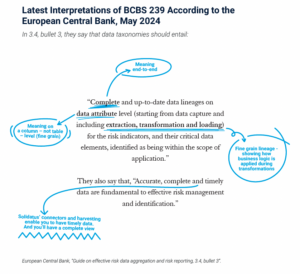
Data lineage work gets funded to address something specific: a supervisory finding, a BCBS 239 remediation plan, or an audit action with a date attached. That obligation sets the scope, so the map stops where the examiner who raised it stopped caring. The people who build it are specialists hired to trace transformations, which is a different skill from explaining one to a business analyst, and what they produce is written to be defended once to an audience that already speaks its vocabulary.
In most initiatives, what comes out is a record expressed in the language of the systems rather than the language of the questions people bring to it. A risk analyst wanting to know which reports depend on a counterparty rating field first needs that question rendered into table and column names, and the colleagues who can perform the translation are the ones the governance program is about to release. From the regulatory side, the fact that BCBS 239 evidence gets rebuilt every examination cycle leads to the observation that compliance evidence assembled to answer one supervisory question rarely stretches to the next.
Gartner’s framing of the governance operating model points at the operational half of the same problem. Its July 2026 note on governance building blocks argues that governance scales only where it operates at runtime, embedded in the platforms and pipelines where data moves, rather than depending on manual escalation.1 A lineage model that needs a specialist intermediary for every question is manual escalation with a diagram attached.
Access is the easy part. A business user who opens a lineage map and finds three thousand tables has been handed something they still cannot use, and no amount of additional permission changes that. Two things have to be true first, and neither of them is a setting.
The lineage model has to answer in the language the question was asked in. Someone investigating a customer address field, a counterparty exposure, or a data retention obligation is asking about a business concept, and no system stores a column under that name. The argument for holding business meaning alongside the technical record is usually made on governance grounds, and it is just as much an adoption argument. Where the model holds only physical structure, every question becomes a translation job queued for a specialist. Where it holds business meaning alongside the physical path, the person with the question starts from the concept they already understand and follows it down to the fields that carry it.
People outside the program also have to be able to change the lineage model without breaking it for everyone else. Editing in place makes every change a risk to someone else’s work, and the governance team responds the way any team responds to that risk, by taking write access back. Solidatus handles this the way engineering teams handle shared code: a change is branched from the live model, compared against it, reviewed by whoever owns the affected area, and merged once accepted. Someone can model a proposed change in a sandbox and show its downstream consequences before anyone commits to it. That workflow is what makes a wide user base compatible with a model people can still trust.
HSBC’s wholesale credit and lending build runs at that scale. More than 500 internal users hold self-service access, and the model governs and maintains over 200,000 transitions.2 Those two numbers depend on each other. Open editing across 500 people would degrade the record faster than anyone could repair it, and routing all 500 through the modeling team would have capped the user count in the low dozens.
A lineage model that only grows fails in a way no coverage statistic reports. Someone asks which system is authoritative for customer address, receives twelve plausible answers, picks one, and builds a regulatory report on it. Volume without editing produces confident wrong answers, and for a risk function that is worse than receiving no answer at all.
HSBC’s program treats reduction as continuing work rather than a tidy-up before an audit. Alongside the mapping, the team set a target of cutting published data assets across credit lending processes from around 10,000 down to 200.3 That editorial judgment never stops. Someone has to decide what counts as authoritative and retire what duplicates it, so the published set stays small enough for a non-specialist to reach the right answer first.
A global asset management firm pointed the same discipline at a transformation instead of a regulator. Its multiyear program moved investment processes off spreadsheets and brought certain asset types in-house, and the lineage model became the reference for the migration. Time to decision fell from months to minutes, and the firm attributes a 60 percent cost reduction to the manual work it removed.4
“Solidatus is the control center from which our entire migration strategy stems – it visualizes our dependencies, reflects build status, eliminates end-to-end failures, and supports change management planning in many areas.”
— Senior Director, global asset management firm
Notice the phrase: control center. Nobody reaches for that language to describe documentation, and the distinction is not cosmetic: a control center is something an operator sits at while the work is happening, which means the model was being read during the migration rather than written up afterward.
No executive funds a second initiative on a record the first one found unusable, which makes expansion the clearest outside evidence that a lineage model became operational. When an engagement closes, and nothing else is ever built on what it produced, that silence is a verdict.
HSBC started in wholesale credit and lending. The lineage model then extended into environmental, social, and governance reporting, liquidity calculations, and risk-weighted asset optimization.5 Those are different owners, different regulators, and different reporting cycles reading one model. None of them commissioned the original work, and none would have adopted something that required the credit and lending team’s help to interpret.
The same pattern appears well outside compliance. A tier 1 global investment bank used Solidatus to consolidate regional daily batches into a single global 24×6 batch, working across several thousand commands and tens of thousands of interdependencies. The same planning had been attempted in spreadsheets first, where estimated effort had already passed six person-months before the bank changed approach.6 Batch scheduling answers to no regulator and was never in scope for the governance program, which is what makes it the more useful example. A team with no stake in why the model was built reached for it anyway.
Five moves separate a governance program that ends from one that keeps running.
The coverage figure is not useless. It answers a fair question about how far the program got, and a steering committee is right to ask for it. It stops being the interesting number the moment the program ends, because from that point what matters is whether the lineage model survives being used by people who never sat in a single program meeting. Count those people. A climbing number means the next regulatory program will cost a fraction of the last one, and a flat number means a rebuild is coming, already sitting on the budget for a year nobody has named yet.
If your lineage is mapped and nobody outside the governance team is using it, that is the conversation to have. Request a Solidatus demo, and we can walk through what an implementation roadmap looks like for your environment.
[1]Bickel, Amy. “Building Blocks for Effective Data Governance in the Age of AI.” Gartner, July 13, 2026. Gartner subscription research, ID G00853417.
[2]Solidatus. “Solidatus models HSBC’s global lending book.” Accessed August 24, 2026.
https://www.solidatus.com/resource/case-studies/solidatus-models-hsbcs-global-lending-book/
[3]Solidatus. “Solidatus models HSBC’s global lending book.” Accessed August 24, 2026.
https://www.solidatus.com/resource/case-studies/solidatus-models-hsbcs-global-lending-book/
[4]Solidatus. “Asset management firm transforms investment environment.” Case study, 2024.
https://www.solidatus.com/resource/asset-management-firm-transforms-investment-environment/
[5]Solidatus. “Solidatus models HSBC’s global lending book.” Accessed August 24, 2026.
https://www.solidatus.com/resource/case-studies/solidatus-models-hsbcs-global-lending-book/
[6]Solidatus. “Solidatus for workload automation: case study for global bank.” Case study, 2022.
https://www.solidatus.com/wp-content/uploads/2024/01/Solidatus-for-workload-automation-case-study-for-global-bank_2022.pdf
01.
Operationalizing data lineage means the lineage model keeps answering questions after the program that built it has closed. A governance program delivers lineage coverage, measured as systems connected and fields mapped. An operational model adds what coverage never measures: people outside the governance team getting answers without help, a named owner maintaining the record between regulatory cycles, and a safe route for those users to contribute changes. HSBC’s wholesale credit and lending model supports more than 500 internal users on self-service access this way.
02.
Coverage counts what a team mapped. Operational value depends on who can use the result. A lineage model covering 90 percent of an enterprise’s data flows delivers nothing if every question about it routes back through the specialists who built it, because those specialists move to the next regulatory program and take the ability to read the model with them. The practical test is whether a non-specialist can answer a routine question unaided. If they cannot, the program produced documentation rather than infrastructure.
03.
A governance program is scoped to one regulatory obligation, staffed by specialists, and built to be defended once to an audience that already speaks its vocabulary. Those conditions produce a record expressed in system names rather than business concepts, readable only by its authors. When the program disbands, nobody owns the lineage model, the systems underneath it change, and the record drifts out of agreement with the environment it describes. The next regulatory request then funds a rebuild rather than a reuse.
04.
Count the people outside the governance team who queried the lineage model in the last month, and track whether that number is rising. Coverage percentages measure effort, while query volume from non-specialists measures whether the model became infrastructure. A second signal is expansion, meaning whether any initiative that did not commission the original work has since built on the model. HSBC’s engagement began in wholesale credit and lending and later reached environmental, social, and governance reporting, liquidity calculations, and risk-weighted asset optimization.
05.
Only where change follows a review workflow, when users edit a shared lineage model in place, every contribution risks someone else’s work, and governance teams respond by withdrawing write access, which ends self-service. Solidatus applies the approach engineering teams use for shared code: a change is branched from the live model, compared against it, reviewed by the owner of the affected area, and merged once accepted. Proposed changes can also be modeled in a sandbox, so downstream consequences are visible before anyone commits.
Published on: September 10, 2026

What your data lineage has to prove before an examiner asks about a past decision

What runtime capture reaches, and what you have to model yourself.

Why a residency commitment is not evidence of custody.

Three criteria that make regulatory data lineage reusable

How data lineage brings assessment discipline to financial services data flows

A buyer's guide to choosing the foundation of your AI stack.

Pre-change impact analysis for data estates that feed AI

What BCBS 239 and SR 26-2 now demand at the column level

MCP support, Bring Your Own LLM, and an assistant that keeps its context

Bi-temporal data lineage is the foundation of forensic AI investigation

Why an AI use policy cannot enforce itself.

How LSEG turned data lineage into a strategic asset for AI trust

What regulators expect when they ask you to prove data lineage

Why catalog-first tools fall short when regulators ask how your training data moved

When an AI model starts producing unexplainable results, the first instinct is to blame the model. Teams often rush to...

Five data lineage myths that the masterclass got right

What regulators are already asking about your AI, and what it takes to respond
Three questions your AI governance approach must answer

Three institutions receive the same question during Model Risk Management reviews: “Walk us through the complete data lineage for your...

Solidatus’ Tina Chace and fellow experts reveal why 90% of AI model failures trace back to upstream data changes

AI-ready data lineage is a comprehensive, auditable record of how data flows through your organization, designed to support AI governance...

In May 2024, the ECB released its ‘Guide on effective risk data aggregation and risk reporting (RDARR)’...
Read why advanced data lineage is crucial for business success
An update on some recent developments in our latest product releases
Read more about data lineage and its business impact, including on AI, BCBS 239 and more
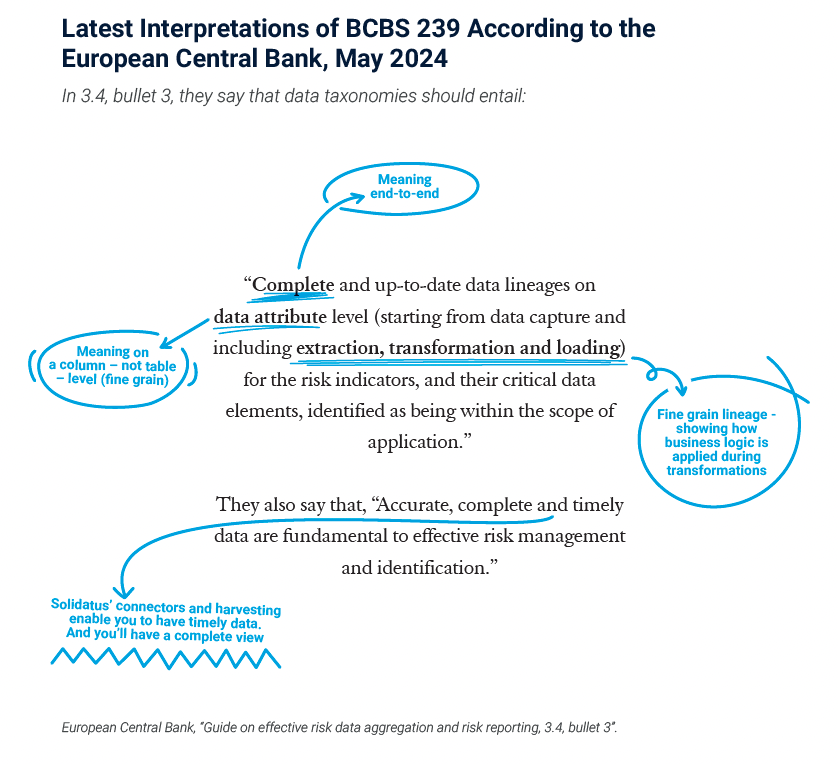
Navigate BCBS 239’s rigorous standards with advanced data lineage
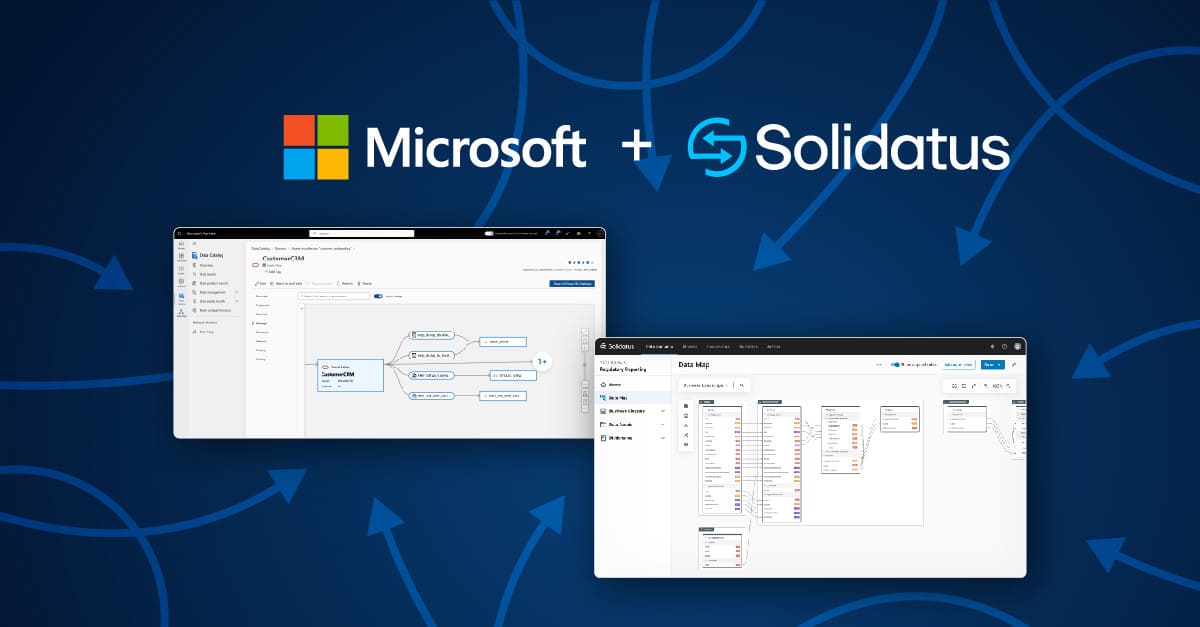
Solidatus data lineage partners with Microsoft Purview to help enterprises trust their data

Read about the new Solidatus interface
Read our key takeaways from Gartner D&A Summit 2024

Video introducing our new interface and core features like Connected Catalog and Data Map
Read about Solidatus and Snowflake Horizon's governance solution
Explore the various aspects of data lineage and its crucial role in your organization.

Basel III is changing – are you prepared? Read 3 easy steps with Solidatus
Read how we helped successfully launched the Houston Women in Data Chapter

Exploring the parallels between urban planning and data planning projects

71% of senior data leaders in financial services polled are close to quitting their jobs

Take a look at what's new in our partnership with Snowflake

VP Product, Tina Chace, reflects on the Gartner conference, covering data governance and AI

We’ve linked the Eurovision Song Contest to the realm of data governance and data lineage

In the latest Gartner® research note, find out what active metadata is

The role of metadata, dynamic visualization and inference across metadata

Automatic connectors are essential for efficiently mapping metadata but not all are created equal. We look at the most important...

We discuss injecting active metadata into your governance and 4 other things we’re looking forward to at the Gartner® Data...