




































Rapidly Develop Knowledge Models Anchored in Data Management Best Practices

Data context has never been more critical – or more complex. In this exclusive webinar for EDM Association members, Solidatus unveiled the next chapter of its partnership with EDM Association, including a new offering for DCAM users, designed specifically for the EDMA community.

Watch this on-demand webinar to see how this new offering – including the AI Assistant for DCAM – is transforming how organizations develop and interact with their knowledge models. The AI Assistant lets teams engage with their knowledge models directly, asking questions, surfacing insight and accelerating governance through natural language.

EDM Association members can now author knowledge models anchored to DCAM and CDMC, effectively moving beyond passive consumption to active contributors to your organization’s data knowledge.


Speakers

Philip Dutton

CEO & Founder, Solidatus

Daniel Waddington

CTO, Solidatus

JimHalcomb

Moderator: Jim Halcomb

Chief Research & Development Officer, EDM Association

Post-event summary

This webinar, “Rapidly Develop Knowledge Models Anchored in Data Management Best Practices,” introduced a new collaboration between the EDM Association and Solidatus designed to help members create, explore, and extend knowledge models using AI-assisted metadata management. Expert speakers included:

  • Moderator: Jim Halcomb, Chief Research & Development Officer, EDM Association
  • Philip Dutton, CEO & Founder, Solidatus
  • Daniel Waddington, CTO, Solidatus

Jim opened the session by announcing Solidatus as an official EDM Association Authorized Technology Partner and explaining how the initiative expands members’ ability to interact with EDM Association intellectual property, including DCAM, CDMC, BCBS 239, GDPR, and other regulatory mappings. The goal is to move beyond static documentation and read-only models toward an interactive environment where practitioners can create, enrich, and share knowledge models while maintaining alignment with established data management frameworks

Philip positioned the discussion within the broader challenges facing data professionals today, including regulatory pressure, growing technology complexity, data lineage requirements, and the rapid adoption of generative AI. He explained that organizations increasingly struggle not because they lack metadata, but because they lack context and connectivity across their metadata assets. Solidatus was designed to address this challenge by creating relationships between data assets, policies, controls, business concepts, and regulatory requirements, enabling organizations to understand how everything connects rather than managing information in isolated silos. Philip emphasized that lineage and contextual understanding have become foundational capabilities for regulatory compliance, transformation programs, data products, and AI initiatives.

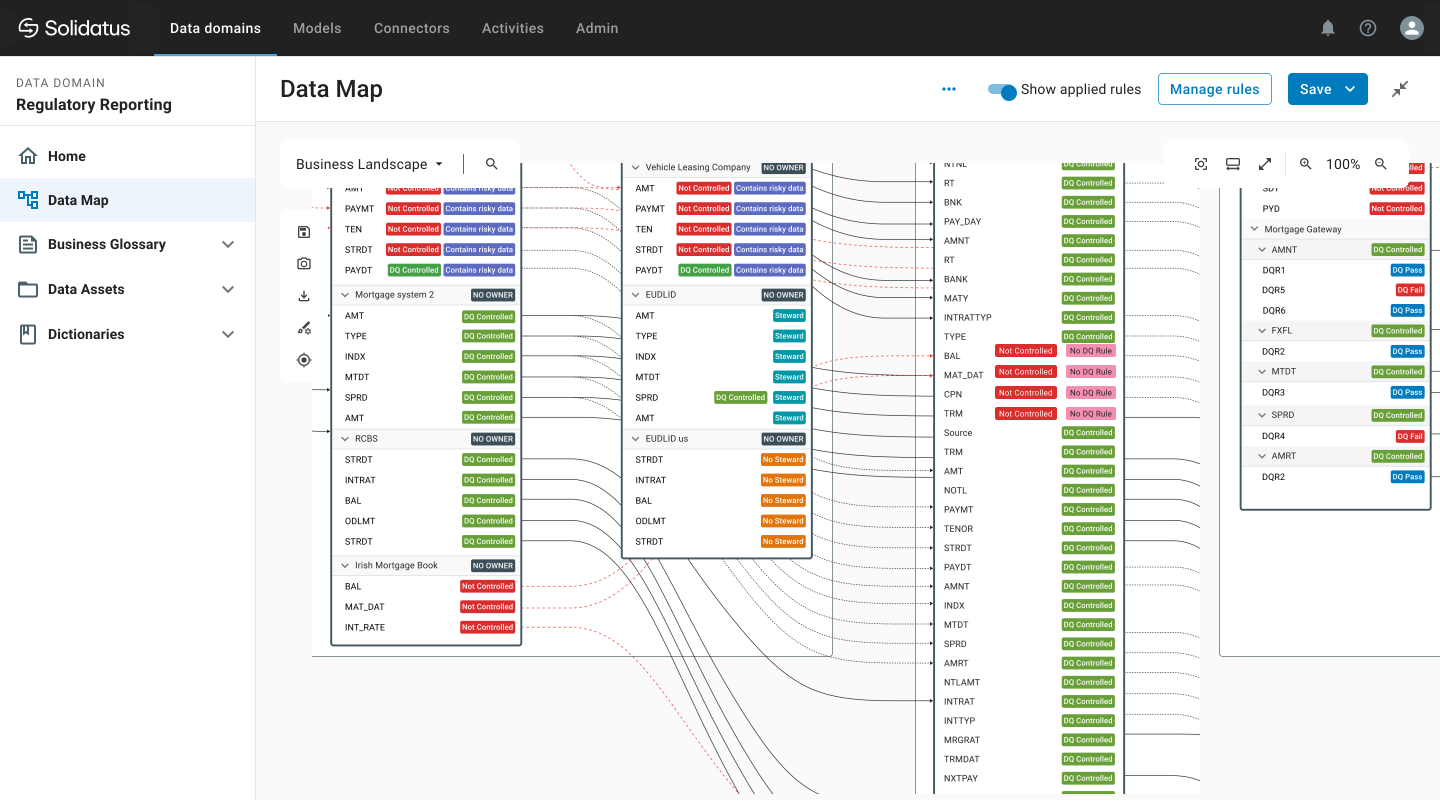
A major focus of the webinar was the introduction of the Solidatus AI Assistant, which combines generative AI with metadata management and knowledge modeling. Through a series of live demonstrations, Daniel showed how users can interact with knowledge models using natural language rather than requiring deep expertise in the platform. The assistant can explain complex models, answer questions about DCAM and CDMC capabilities, identify where concepts such as data lineage are represented within frameworks, and help users navigate large collections of metadata. Daniel demonstrated how the assistant can analyze physical data lineage models, identify potentially sensitive data elements, recommend missing metadata, and automatically apply classifications such as PII risk tags while maintaining full user oversight through visual change tracking and approval workflows. As Daniel explained, “It’s your partner in metadata management to help you understand these concepts, to dig into the details, and sort of help you understand some of the complexity that Solidatus is often trying to surface and model.”

The session also highlighted the assistant’s ability to accelerate knowledge model creation from both structured and unstructured sources. Demonstrations showed how code, SQL scripts, Python notebooks, diagrams, PDFs, and other documentation can be ingested and transformed into structured lineage and metadata models. Rather than manually documenting relationships, transformations, and business context, users can leverage AI to extract, classify, and enrich metadata while still retaining review and governance controls. Speakers emphasized that this capability significantly lowers the barrier to entry for metadata management and enables broader collaboration across the data community.

Insights and Articles

Blog

Lineage tools forget what your AI model saw

Bi-temporal data lineage is the foundation of forensic AI investigation

LSEG’s journey from regulation to revenue through data
News

LSEG’s journey from regulation to revenue through data

Shift comes as EU regulation pushes global banks’ data overhaul

On Demand

Webinars and Events

Knowledge Models Webinar

Data context has never been more critical – or more complex. In this exclusive webinar for EDM Association members, Solidatus...